Francesco Ippolito, 3 February 2020.
- Why this survey?
- Bali, a brief intro.
- Overtourism.
- Ever-growing rate of tourist arrivals.
- Bali road traffic conditions.
- Air pollution.
- Freshwater sources depletion.
- Rising crime rate.
- Low-level and unruly tourism.
- Natural disaster risk.
- Overdevolepment.
- Poor waste management and environmental crisis.
- Corruption and red tape.
- Radical Islam and the Islamization attempts of Bali: political and religious issues.
- Tourism industry, how's it performing, and what to expect?
- Real estate market, what's happening and where is it going?
- Land prices.
- Building costs.
- Holiday villa market.
- The law and regulations concerning buying and owning property in Bali/Indonesia.
- VISAs.
- Conclusions.
- Books.
Why this survey?
Anyone who has visited Bali knows how quickly one falls in love with the island. Its climate, culture, natural beauty, warm hospitality, and spirit of tolerance make it an irresistible destination. It’s no surprise that, on the journey home, many travelers are already planning their next trip back.
Quite often, these returning visitors begin to consider buying property—whether as a future retirement home, a rental investment to generate income, or even a permanent base on the island. This is exactly my case.
What begins as a dream can easily turn into concrete plans. However, before turning those plans into reality, one essential question must be asked: do you have enough knowledge of Indonesian property regulations and requirements? What about tax obligations, visa regulations, and the specific laws governing property ownership? These are crucial aspects to understand. Without the right information, a tropical dream can quickly become a tropical nightmare.
This is precisely the purpose of this survey: to provide clear answers to these questions.
I have traveled extensively around the world and experienced life in different places. Among them, I spent two years living in Bali, from which I finally departed at the end of April 2011. My move to Bali was driven by a clear plan: to invest in the local real estate market. My intention was to build a home for myself and develop a few additional properties, either for short-term rentals or for resale, generating an income to live on. Alternatively, I had also considered creating a small boutique resort.
Like many others, I fell in love with the Island of the Gods and wanted to make it my permanent home. However, after two years of exploration and first-hand experience, I came to a different conclusion. There were too many critical issues and no real conditions or signs that could justify hoping for better prospects. Unfortunately—as I anticipated—many of the negative aspects I foresaw have since materialized on a larger scale.
Since leaving, I have never returned to Bali. Yet the island has always held a special place in my heart, and I have often thought that one day I would move back. Before taking that step, I decided to organize and summarize the information I collected daily over two years—covering Bali’s tourism market, the real estate sector linked to it, and the related legal and bureaucratic aspects. This work serves as my personal guidebook, a practical reference to navigate the Balinese environment, which is certainly not among the easiest or safest in the world.
There is, however, a clear limitation to this analysis: it was developed entirely from behind a computer screen, far from Bali. It relies on a wide range of online sources, without the benefit of direct, on-site verification.
On this point, long-time resident and Bali observer Susi Johnston once noted a striking lack of systematic data collection, organization, reporting, and archiving within public agencies in Bali—an issue mirrored in private enterprises and NGOs. Even leading Southeast Asian property consulting firms often possess only fragments of information, while the local statistics offices lack consolidated, reliable datasets or even the raw inputs needed to build them.
My experience during research aligns with this: the scarcity and uneven quality of data require caution. I therefore explored the internet in its most hidden corners to gather enough material to support reasoned conclusions—yet, in the absence of comprehensive official statistics, findings must be read with a prudent, relative mindset.
Johnston also warned about a global “closed-loop information” effect: decision-makers in multiple cities, relying on the same limited datasets and similar models, often rush to execute identical ideas in parallel—an obvious risk for a place as sensitive as Bali.
Solid preparation and thorough information gathering are essential when investing in any country. To address the data gap, I chose to build an analysis as structured and well-documented as possible. Despite inherent limitations, I believe this survey remains useful for anyone considering moving to Bali or investing there. At the end of the document, I provide a complete list of sources used.
Methodological note — Update 2025
While the structural data constraints in Bali persist, today there is better access to official statistics and sector reports than when this survey was first drafted. In this 2025 update, I incorporate triangulated evidence from public statistics, market research, and regulatory texts where available, while maintaining the same cautious interpretive stance set out above.
- Bali, a brief intro.

Bali is an Indonesian island located at the westernmost tip of the Lesser Sunda Islands, nestled between Java to the west and Lombok to the east.
Often referred to as the “Island of the Gods,” Bali captivates visitors with its stunning natural beauty: towering volcanoes, lush terraced rice fields, and a sense of peace and serenity that permeates the landscape. It is also world-renowned as a surfers’ paradise. Its beaches, with both white and black sands, attract every type of traveler, making Bali Indonesia’s premier tourist destination and a true gem for visitors from around the globe.
Beyond its breathtaking scenery and countless attractions, Bali offers a vibrant cultural tapestry. The island’s life and traditions are deeply influenced by Hinduism, the predominant religion, which shapes both the spiritual and everyday life of most of its people. The warmth and hospitality of the Balinese, combined with their unique and harmonious cultural heritage, make the island a distinguished destination not only for international travelers but also for domestic tourism—earning Bali its reputation as one of the most sought-after destinations in the world.


Located about 8 degrees south of the equator, Bali enjoys a typically tropical climate—warm and humid throughout the year—with two distinct seasons: the dry season (April to October) and the rainy season (November to March).
In the central part of the island, several volcanic peaks rise above 3,000 meters. These higher-altitude areas are noticeably cooler than the coast and receive significantly more rainfall.

- Overtourism.
We have just explored the qualities that make Bali such a magical place, capable of attracting tourists like a magnet. Yet, there is also a darker side to this story, which we now need to address.
Bali has, in many ways, become a victim of its own success. After decades of steadily increasing tourist arrivals, the island now faces severe challenges. Strained by inadequate infrastructure and limited freshwater resources, Bali is approaching a point of crisis.
Traffic congestion is horrendous. Road accident statistics are alarming, and air pollution has become a silent killer. Commuting is endless and exhausting.
Public transportation, limited almost exclusively to taxis, often turns into an unpleasant experience—especially when opting for online ride-hailing services such as Uber or similar platforms. These frequently lead to tense confrontations with the local “taxi mafia,” making mobility around the island even more challenging.

Crime is on the rise. Violent muggings, burglaries, hordes of unruly tourists involved in bar and street brawls, credit card skimming—the list goes on. Daily life can easily turn into a constant battle, which is far from what one dreams of when enjoying a well‑earned holiday or trying to settle here as an expat.
Land pollution is another serious issue. Waste management is poor to nonexistent: trash piles up in the streets, is burned in the open air with foul smells and toxic fumes, or is dumped into rivers. Once pristine beaches are now clogged with garbage, and the same goes for the ocean. These scenes hardly make for the perfect Instagram shot.
When the police are visible on the streets, it is often more to seek profit from foreigners (bule) than to enforce the law. Meanwhile, government officials and local authorities appear too preoccupied with personal matters to pay serious attention to these problems.

These are just some of the problems Bali is facing as a result of overtourism. Let’s now take a closer look at these issues—and others—in more detail.
- Ever-growing rate of tourist arrivals.
In 1979, Bali welcomed around 130,000 visitors. Over the next four decades, arrivals expanded at an average pace of roughly five percent per year, reaching more than 6.5 million foreign visitors in 2018
After a dramatic collapse in 2020 and 2021 due to global travel restrictions, international arrivals rebounded strongly. By 2024, they had returned to, and in many months exceeded, pre-pandemic levels, once again surpassing six million foreign visitors for the year. Domestic tourism recovered even faster, adding substantial volume on top of international demand and reinforcing Bali’s position as Indonesia’s flagship destination.
This rapid recovery has amplified long-standing structural pressures. Airport throughput, arterial roads in the southern corridor, water and waste systems, and public services have struggled to keep pace with the renewed influx. The result is persistent congestion, longer travel times between key hubs, and periodic service bottlenecks during peak seasons
The pattern of visitation has also become more volatile, with sharper swings between high and low seasons than a decade ago. While this dynamism creates opportunities for businesses that can flex pricing and operations, it also increases operational risk for those with fixed-cost structures and limited yield management capabilities
In summary, Bali’s appeal continues to drive demand well beyond pre-pandemic benchmarks, but the sheer scale and seasonality of arrivals—international and domestic—are once again testing the island’s infrastructure and the quality of the visitor experience
- Bali road traffic conditions.


This relentless traffic not only makes it extremely difficult to move from point A to point B, but also discourages visitors from exploring the island. As a result, many tourists end up limiting themselves to a small area around their hotel, missing out on the real Bali.
Traffic has become a constant daily threat. With roads perpetually clogged, both locals and visitors increasingly rely on motorbikes as their main means of transportation. However, the streets often resemble a state of total anarchy, with little to no regulation.
This chaotic situation leads to a very high number of accidents, many resulting in severe injuries, sometimes fatal or permanently disabling. Tourists are frequently among the victims, often riding without helmets, sometimes under the influence of alcohol or drugs, putting themselves and others at serious risk.
In this regard, I strongly recommend exercising the utmost caution when driving in Bali—whether by car or, even more so, by motorcycle. Never, under any circumstances, ride without a helmet, as many irresponsibly do, and never drive under the influence of alcohol.
Always carry a valid driving license: either an international license or an Indonesian one if you are a long‑term resident. Equally important is to have comprehensive insurance that covers all costs, including repatriation or emergency air evacuation with medical assistance to destinations where healthcare facilities are more advanced—such as Singapore. In serious situations, Bali is not always the best place to receive adequate treatment.
For those who tend to underestimate these warnings, here is a case report—just one example among many—that unfortunately has become an almost daily occurrence.


Mobility is indeed a critical issue. Discouraged by the difficult and often dangerous traffic conditions, many people choose not to drive any kind of vehicle themselves. However, Bali lacks a proper public transportation system.
While services like Uber and Grab are available, they are in constant conflict with local taxi drivers. The rivalry has escalated into an ongoing battle: angry signs along the roads warn against ride-hailing services, and there are frequent horror stories of Uber or Grab cars being stopped, passengers forced out, and drivers threatened by taxi operators. As a result, what should be a convenient service often turns into a dreadful experience.


As already mentioned, those who choose to drive cars or motorbikes in Bali expose themselves to the risk of road accidents, often with serious consequences—both physical and financial. In a corrupt system, foreigners (“bule”) are almost always held accountable regardless of the actual circumstances, and are often treated as an easy target for extracting money.
There is also a significant flaw in Bali’s traffic accident statistics, as most accidents—especially those involving only injuries—are not officially reported. Only fatalities are consistently recorded.
According to the provincial Traffic Police, around 1,500 people die in traffic accidents in Bali each year, averaging four deaths per day. Of these, 80% (approximately 1,200) are motorbike users. Based on a general rule of thumb, for every death, there are about five severely injured individuals (requiring professional medical treatment and repeated visits to doctors or clinics). This suggests that around 6,000 motorbike riders suffer severe injuries annually.
In addition, minor injuries (those treated with simple first aid, a single clinic visit, or basic medical attention) occur at a ratio of roughly 2 to 1 relative to severe injuries. That means there are approximately 12,000 motorbike riders each year in Bali who sustain minor injuries.

Being a “bule” on the road in Bali, here is a clear example of how you are likely to be treated in the event of an accident:
Suddenly, a scooter crashed into their car. The male rider was drunk, had no license, and was not wearing a helmet. He was rushed to the hospital. Despite being clearly in the right, she was arrested—simply because she had a foreigner in the car.
She was taken to the Mengwi police station, where her fiancé was told to come up with tens of millions of rupiah, not an easy task in a foreign country at Christmas time. The more money he managed to gather, the more they demanded. After the man eventually died, his family refused to sign the release papers until they had received a large payment. Once the rider passed away, the requested amount skyrocketed. As of last night, the demand had reached over 80 million rupiah, plus legal fees.
Had there been no foreigner in the car, she would never have been arrested. This is corruption at its worst. To make matters even more tragic, she is pregnant. Today marks seven days that she has been imprisoned—despite having committed no crime at all—held hostage for her fiancé’s extortion, sanctioned by both the police and the courts, who will all take their share.

Is there any indication that the local authorities are aware of how unsustainable this problem has become—and of how vital it is to address it, both for the health of Bali’s tourism industry and for the quality of life of the Balinese community as a whole?
Here is a recent piece of news on the subject:

The question is: why stop at Kuta and not extend it all the way to Canggu?
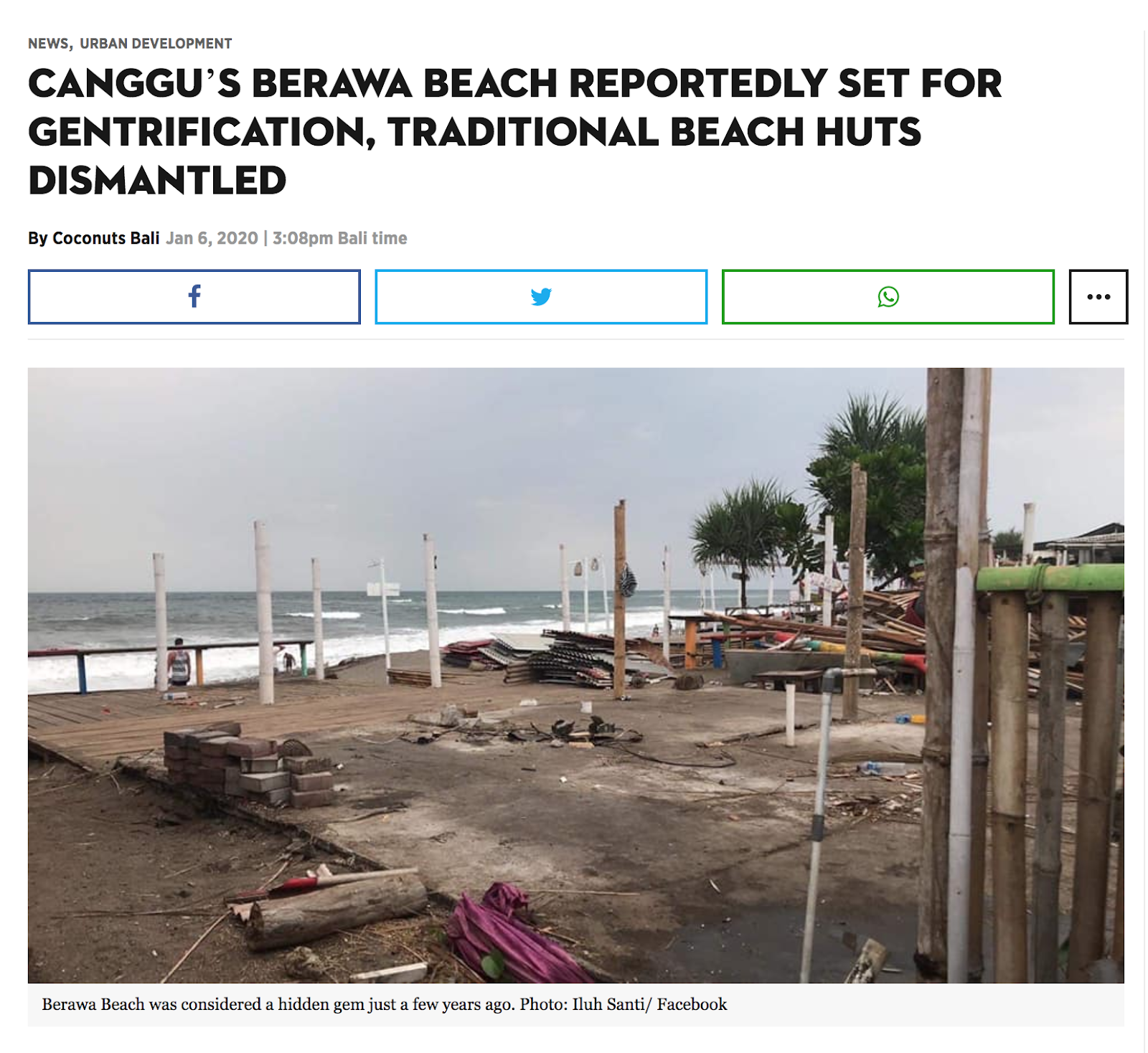
With its eclectic mix of restaurants, street art, coworking spaces, yoga studios, boutique hotels, and Hindu temples set among dreamy green rice fields, Canggu has become an Instagram hotspot and the most desirable residential area for many of the 30,000 expats living in Bali. Over the years, they have leased or built all kinds of villas in this area.
Will this measure be enough? And when will it become fully operational?
- Air pollution.
All of this is accompanied by a dangerous decline in Bali’s air quality. According to the Air Quality Index issued by the Energy Policy Institute at the University of Chicago, current pollution levels in Indonesia have reduced the average life expectancy by five years. Experts warn that air quality in Indonesia is deteriorating rapidly, placing it among the countries with the worst pollution levels in the world—alongside India, China, Bangladesh, and Pakistan.
Since Bali’s economy depends heavily on tourism, addressing air quality must become a major priority for the island’s leaders if they wish to protect and strengthen visitor numbers in the years to come.

- Freshwater sources depletion.
Millions of international and domestic tourist arrivals have placed immense pressure on Bali’s already limited freshwater resources. Hotels and other tourist facilities rely heavily on groundwater, leading to over-extraction that alters soil salinity and poses a serious threat to farming.
To make matters worse, prolonged droughts affecting the whole of Indonesia have further aggravated the situation. The outlook is far from promising, making water scarcity one of the most serious challenges currently facing Bali.


- Rising crime rate.
The paradise island is facing a rising wave of crime that increasingly puts tourists at risk of injury and even death.
Every day, thousands of tourists rent scooters to move around Bali, making themselves easy targets for opportunistic criminals. What often begins as a simple theft—when a thief snatches a purse or a phone from a passing motorcycle—can quickly turn tragic. Victims frequently lose control, crash, or are dragged off their scooters, resulting in severe injuries and, in some cases, death.
And the threat isn’t limited to scooters. Tourists walking down the street are also falling victim to purse snatching and phone grabbing. What was once a peaceful and tranquil island has, in recent years, become a hotspot for such criminal activity.

All of this has reached a level that casts a shadow over the image of the “Island of the Gods,” leading many people to reconsider traveling to Bali. This shift carries potential consequences for the tourism sector and the real estate market that depends on it.
The situation has become so concerning that Bali was even included in Fodor’s “No-Go List” for 2020.

Other forms of crime are also on the rise, including burglaries and house break-ins.


<<< >>>


all kinds of frauds and scams, etc.
This is far from the ideal scenario for the discerning traveler—the very type of visitor Bali should be focusing on.
Is there hope that the authorities will finally begin to address these problems? Local officials seem to be showing some signs of awareness, but how effective their actions will be remains to be seen.

If crimes committed by tourists have raised concerns among local authorities, what about the violent muggings, burglaries, and other offenses committed mostly by impoverished individuals from neighboring islands who come to Bali determined to claim their slice of the pie at any cost?
Bali has experienced a massive tourism-driven construction boom, which has brought with it an enormous influx of workers, mainly from Java, to fill jobs in construction and services. This rapid growth has also deepened the gap between the “haves” and the “have-nots,” both among locals and foreign residents. The result has been a significant increase in population—and with it, a rise in violence, robberies, and bag snatching.

(A must-read on the topic of Muslim migration from neighboring islands)


While the police do little to prevent these crimes, local residents have begun taking matters into their own hands against these incoming offenders—many of whom are of Muslim faith—creating conditions that could potentially fuel rising racial and religious tensions.

- Low-level and unruly tourism.
With mass tourism inevitably comes a large number of unruly visitors—both international and domestic—and this is beginning to erode Bali’s social environment.
According to various media reports, this summer alone saw a string of troubling incidents: an Indian family was caught stealing from a hotel and publicly shamed after a video of their stash went viral; a Muslim tourist brandished a knife at beachgoers, ordering them off the sand in front of his villa; a Russian traveler was jailed after being arrested at Denpasar airport for attempting to smuggle an orangutan, two geckos, and five lizards out of the country; an intoxicated Australian man went on a half-naked rampage, fly-kicking a motorcyclist and jumping onto the hood of a moving car, among other offenses; and a Czech couple caused public outrage when caught on camera disrespecting a religious site.
Bar and street brawls have become a daily occurrence, with relentless numbers of drunk and aggressive tourists making international headlines. As The Guardian noted, the island has experienced a decline in the type of traveler it now attracts.
Who, after all, wants to experience the “Island of the Gods” alongside a crowd of reprobates?


Some may argue that the situation is not as serious as the media portray it, pointing out their tendency to sensationalize in order to sell stories. Yet, even if that were the case—which it is not—these kinds of headlines circulate internationally, damaging Bali’s reputation.
This kind of negative publicity does nothing to promote tourism or preserve the value of real estate investments. Sooner or later, if there is no reversal of this trend, tourists, buyers, and investors alike will start to view Bali as a no-go zone. To some extent, this shift has already begun.
- Natural disaster risk.
Another critical factor not to be underestimated in Bali—and Indonesia as a whole—is the risk of natural disasters. The island is home to the unpredictable Mount Agung, an active volcano located in the northeast, and lies within the so‑called “Ring of Fire”: a 25,000‑mile (40,000 km) horseshoe‑shaped zone of intense volcanic and seismic activity that traces the edges of the Pacific Ocean.
The Ring of Fire, named for its fiery nature, contains 452 dormant and active volcanoes—around 75% of the world’s active volcanoes—and is responsible for about 90% of global earthquakes.

What if you invest in a beautiful, expensive beachfront property—only for a major earthquake to strike the next day, triggering a massive tsunami? Your real estate assets could be partially or totally destroyed, and your own life could be at serious risk.
Indonesia has a long history with tsunamis. The most recent, in September 2019, struck northern Sulawesi, leaving a devastating toll of 4,340 fatalities. Now imagine the apocalyptic scenario that could unfold under similar circumstances in the densely populated, poorly infrastructured, and chaotic areas along Bali’s southern coast.


This factor must also be taken into account when assessing the feasibility of any real estate investment in Bali.

It is worth noting, however, that according to news from just a few days ago, the government is finally starting to consider ways to address this problem.

Will this be enough to make a real difference?
- Overdevelopment.
Bali is experiencing severe environmental degradation caused by the mass development of resorts, hotels, villas, and other facilities that have far outpaced the island’s infrastructure.
Between 2013 and 2018, approximately 550 hectares—about 0.4% of Bali’s land—were converted each year into new villas, hotels, and restaurants, and the trend is still increasing. To make matters worse, much of this land was formerly productive rice fields.



Here are some of the comments posted on Facebook:


Check the Facebook page "Bali: How Much Is Too Much?" created by Susi Johnston.

- Poor waste management and environmental crisis.
Another negative consequence of these trends is the massive production of waste and its poor management. Every 20 minutes, the equivalent of a 10-ton truckload of plastic is dumped into the waters surrounding Indonesia.
In Bali—the country’s top tourist destination—this issue has already reached a catastrophic scale. The island’s basic infrastructure has been unable to keep pace with the rapid urbanization driven primarily by overtourism, but also by other factors, leaving the problem largely unaddressed.


Some parts of the island, however, seem to react faster than others when problems are exposed by the press. Just a few weeks ago, the following report was released:


- Corruption and red tape.
According to the World Bank, Indonesia ranks as the worst place in Southeast Asia to start a business. Inefficient bureaucracy and widespread corruption are among the biggest obstacles for foreign investors.
The root of the problem lies in the country’s bloated and compromised public administration. There are no quick fixes: an overgrown civil service creates endless opportunities for corruption to infiltrate all levels of government. In 2016 alone, ten regional heads and a provincial governor were arrested by the Corruption Eradication Commission on graft charges.
Many believe that Indonesia’s bureaucratic system has been hijacked to serve the interests of politicians and their parties. Policy changes will remain ineffective until this underlying issue is confronted. Like a disease, once corruption and bureaucracy take root, they are extremely hard to eradicate—and in Indonesia, they have spread throughout the entire public sector.

Despite government efforts to address these issues, rampant corruption and bureaucratic red tape continue to plague the nation, making Bali a particularly challenging business environment.
According to the World Bank, Indonesia ranks as the worst place in Southeast Asia to start a business. Inefficient bureaucracy and widespread corruption are among the biggest obstacles for foreign investors.
The root of the problem lies in the country’s bloated and compromised public administration. There are no quick fixes: an overgrown civil service creates endless opportunities for corruption to infiltrate all levels of government. In 2016 alone, ten regional heads and a provincial governor were arrested by the Corruption Eradication Commission on graft charges.
Many believe that Indonesia’s bureaucratic system has been hijacked to serve the interests of politicians and their parties. Policy changes will remain ineffective until this underlying issue is confronted. Like a disease, once corruption and bureaucracy take root, they are extremely hard to eradicate—and in Indonesia, they have spread throughout the entire public sector.

- Radical Islam and Islamization attempt of Bali, political and religious issues.
Over the past two decades, Indonesia has repeatedly made global headlines due to terrorist attacks and the presence of terrorist networks—including training camps—linked to groups such as Al‑Qaeda, the Southeast Asian Islamist organization Jemaah Islamiyah, and the Islamic State (IS).
These incidents highlight the presence of a radical Muslim community in Indonesia: one that believes Islam should be the sole guiding principle of life, rejects the secular government and pluralist society, and is willing to use extreme measures—including violence—to reshape the country.
With around 250 million Muslim inhabitants, Indonesia is home to the largest Muslim population in the world. Approximately 13% of the world’s Muslims live within its borders. As a result, Islamic principles and ethics exert a profound influence on Indonesian society, politics, and the economy.
This influence stems from a centuries‑long process of Islamization, which has never ceased and remains active in modern times. In recent decades, this process has become particularly visible:
Over the past 20–25 years, the number of Indonesian women wearing the Islamic headscarf (kerudung or jilbab) has risen sharply, making it a common sight throughout the country.
Today, even non‑Muslim Indonesian officials often begin their speeches with the Arabic greeting As-salāmu ʿalaykum (“Peace be upon you”).
The process of Islamization does not advance uniformly. Instead, it experiences periods of acceleration. A recent example of such a boost occurred during the 2014–2019 period.
When Joko Widodo left his position as governor of Jakarta to successfully run for president, he was replaced (as required by law) by his deputy, Basuki Tjahaja Purnama—better known as Ahok—a Christian of Chinese descent. For many conservative Muslims, it was unacceptable for a non‑Muslim to govern a Muslim‑majority city.
Religious tensions escalated dramatically, and when Ahok, during his 2017 gubernatorial campaign, made a remark suggesting that a specific Quranic verse should not be used to manipulate voters, hardline Islamic groups branded his words as blasphemous. This sparked massive protests demanding his arrest.
A series of large demonstrations, known as the “212 Action” (referring to the first protest on December 2, 2016), drew up to 200,000 people to the streets of Jakarta, with many traveling from other parts of Indonesia to join the movement.
These hardline demonstrations placed enormous pressure on Indonesian society. Under the threat of being labeled anti‑Islam, many people felt compelled to display their Muslim identity more visibly. For example, social media users who previously had profile pictures in Western‑style clothing suddenly replaced them with images taken in front of mosques, dressed in Islamic attire. People who had never used Arabic (Islamic) greetings or phrases began doing so, and women who had not worn a headscarf started wearing one in public.
The hardliners not only succeeded in pressuring society but also in preventing Ahok from winning Jakarta’s 2017 gubernatorial election. Although Ahok initially enjoyed high approval ratings, his popularity collapsed under the weight of the mass demonstrations. He was eventually sentenced to two years in prison in a highly controversial blasphemy case, with many assuming that the judges were acting under political and social pressure.
The tensions that began in Jakarta quickly spread to the national level. President Joko Widodo—seen as an ally of Ahok—became the next target of these hardline groups. During the 2019 presidential election campaign, their influence grew significantly. Losing presidential candidate Prabowo Subianto openly aligned himself with the hardliners, viewing them as a tool to defeat Widodo. It is widely believed that Subianto sought to inflame religious tensions to replicate the events that had unfolded in Jakarta in 2017.
However, Widodo made an unexpected and strategic “act of self‑defense” when he chose renowned conservative Muslim cleric Ma’ruf Amin—Chairman of the Indonesian Ulema Council (MUI)—as his running mate for the 2019 election. Amin, who had issued several conservative fatwas as head of the MUI, was widely respected within hardline circles and had even testified against Ahok in the blasphemy case.
This decision proved to be a masterstroke: by selecting Amin as his vice‑presidential candidate, Widodo made it virtually impossible for his political opponents to label him as “anti‑Islam” or an “enemy of Islam.” As a result, religious tensions largely subsided.
However, the events surrounding Jakarta’s 2017 gubernatorial election and Indonesia’s 2019 legislative and presidential elections had one significant side effect: they accelerated the process of Islamization. Many women who, under social pressure, began wearing headscarves during the height of religious tensions continued to wear them even after tensions eased.
In this sense, Ahok’s period as governor of Jakarta produced an outcome that was almost the opposite of what many had hoped for. While Christians and other minorities celebrated the idea that a Muslim‑majority city could be governed by a non‑Muslim—a symbol of Indonesian pluralism—the resulting backlash triggered a new wave of Islamization. Indirectly, one could argue that the presence of a conservative Muslim cleric as Indonesia’s vice president can be traced back to Ahok’s tenure as governor of Jakarta.


Bali is the only region in Indonesia where the majority of the population is Hindu—although Balinese Hindus represent only about 2% of the country’s total population. On the island itself, approximately 90% of the population is classified as Hindu. However, the most recent census does not account for the influx of predominantly Muslim migrants who have settled in Bali since the 1990s.
To date, Muslim migrants and the Hindu-Balinese majority have coexisted peacefully. Even the Kuta bombings of 2002 and 2005—carried out by radicals from outside the island—did not fundamentally change this pattern of tolerance.
Overall, tolerance still prevails. However, there is an underlying trend toward social separation between the Muslim and Hindu communities in Bali. Going forward, the island may need to develop a new form of tolerance: one not based on the idea of “sameness” between Hinduism and Islam, but rather on the acceptance of their profound differences. This will be a challenge for the future.

An article in International Traveller describes Bali as “a vibrant sanctuary of Hinduism nestled among the thousands of Islamic islands that make up the Republic of Indonesia.” Compared to the laid‑back color and glamour of Hindu Bali, Indonesia’s Islamic cultures simply lack the “X‑factor” that draws international tourists.
However, Bali’s demographic profile is changing rapidly. In 2000, Indonesia’s national census revealed that just over 10% of Bali’s permanent population was Muslim. By 2010, that figure had risen to about 15%. In some areas, the percentage is much higher.
In the district of Jembrana, at the western end of Bali and directly adjacent to Java, Muslims now account for more than 35% of the population. In Greater Denpasar—the urban area that includes Denpasar city and the southern peninsula where most tourists stay—more than 25% of the permanent population is Muslim. These numbers continue to grow at a rapid pace.
Today, Indonesian tourists—overwhelmingly Muslim—far outnumber foreign tourists. The country’s main Muslim holiday, Eid al‑Fitr, has become the busiest time of year in Bali, with visitors from Java and other islands filling every type of accommodation, from budget lodgings to luxury five‑star resorts.
Specialized halal tours for Muslim travelers have become big business in Bali. These tours cater to Muslim visitors by avoiding prohibited foods (especially Bali’s beloved pork dishes), including visits to mosques, and providing accommodations where alcohol consumption and drunken behavior are discouraged.
However, the rapidly growing Muslim presence has generated underlying tensions with the island’s indigenous Hindu population. The Bali bombings dealt a heavy blow to the island’s economy and, in their aftermath, resentment toward Muslims increased among some Hindus—especially in areas where competition for jobs pits the two communities against each other.
Indonesia’s anti-pornography law, enacted in 2008, was strongly resisted in Bali and its enforcement was deliberately diluted. On the island, the law was widely viewed as an Islam-inspired attempt to sideline Hindu ethics and traditional Balinese cultural practices, as well as an effort to impose a puritanical moral code on Bali’s relaxed tourism industry.
Despite these challenges, the Balinese have shown remarkable tolerance. So far, anti-Islamic sentiment has remained muted and has been carefully managed by the provincial government. This restraint is partly driven by economic reality: Bali’s economy depends almost entirely on tourism, and visitor numbers are susceptible to social unrest. Moreover, Muslims now represent one of the largest groups of visitors to the island, and a significant share of tourism investment and management expertise also comes from Muslim entrepreneurs. Alienating Muslim tourists, managers, and investors could have serious consequences for the island’s economy.


Meanwhile, there are occasional attempts by Islamist forces to extend the process of Islamization to Bali. Proposals to ban alcohol, extra‑marital sex, same‑sex relationships, and initiatives to develop “halal tourism” continue to meet with resistance on the island—but for how long can this opposition hold without triggering social unrest?
One of the most controversial proposals is a bill to outlaw the production, sale, and consumption of alcohol across Indonesia. Industry leaders warn that, if passed, this law would devastate the tourism sector. “No matter how beautiful the country is, if they can’t find alcohol, tourists won’t want to come here,” said Hariyadi Sukamdani, head of Indonesia’s Hotel and Restaurant Association.
There is simply too much at stake with an alcohol ban. But the question remains: do Islamic hardliners care? Signs suggest that rallies and pressure will continue, and it is increasingly difficult to predict if—and for how long—Bali can resist the growing influence of Islamist forces. One thing is sure: Muslim hardliners are unlikely to give up.


The same pressure applies to issues such as sex outside of marriage and same-sex relationships.
Indonesia, the world’s largest Muslim-majority country, has long prided itself on being a tolerant nation with a diverse mix of ethnicities and religions. However, in recent years there has been a rise in intolerance toward religious and sexual minorities, driven by increasingly assertive religious conservatives.
A petition submitted to Indonesia’s Constitutional Court proposes amending the criminal code to criminalize sex outside of marriage as well as same-sex relations. Human Rights Watch has described the petition—and the mindset behind it—as dangerous.
This development comes only months after a closely contested election that pitted progressives against Islamic hardliners and highlighted growing concerns about the increasing involvement of Islamic groups in national politics.
Rights groups warn that many of the proposed articles would discriminate against women, religious minorities, and members of the LGBT community, as well as stifle freedom of speech and freedom of association. Under the draft law, extramarital sex could be punished with up to one year in prison, and couples could face prosecution if a close family member files a complaint with the police.
While the article does not specifically mention same-sex conduct, it effectively criminalizes all same-sex relationships. The LGBT community—already subject to persecution and discrimination in the country—could also be targeted through a vaguely worded clause that criminalizes “obscene acts,” punishable by up to six months in prison.
Unmarried couples who are reported to the police for living together could face up to six months in prison or a fine.
Among many changes to existing laws, the draft penal code also stipulates that only doctors may authorize and perform abortions. A woman who undergoes an abortion could face up to four years in prison, while anyone assisting her could be sentenced to five years.
The proposed code would also criminalize insulting the president or vice-president, raising serious concerns about press freedom and the suppression of dissent.
According to the head of the Indonesia Legal Aid Foundation, the new penal code (known locally as RKUHP) represents a major setback for democracy in the country. Another provision expands the current blasphemy law while maintaining the maximum five-year prison sentence, as noted by Human Rights Watch.
Many observers view these reforms as clear evidence of hardline religious influence on politics—an issue that was central during recent elections—and as a sign of growing Islamic conservatism and intolerance toward minorities in Indonesia.
If passed, the law would mark a decisive step toward transforming Indonesia into a de facto Islamic state.


Australian entrepreneur Elizabeth Travers—who manages 30 villas across Bali—has already begun receiving a wave of cancellations.
“The law hasn’t even changed yet, and I’ve already had cancellations. One client told me they no longer feel safe coming to Bali because they aren’t married,” Ms. Travers told The Daily Telegraph.
After 15 years of living on the island, she believes these strict new laws could damage tourism more severely than volcanic eruptions.
“I have traded through two bombings and multiple natural disasters, and I think that if the central government is serious about enforcing such laws, the tourism industry would be destroyed—and it would trigger the end of life in Bali as we know it,” she said.

Awareness of the potential impact on the tourism industry—which is expected to contribute around 8% to the national GDP and generate approximately IDR 240 trillion in foreign exchange—combined with widespread student protests, has triggered a global backlash

that pushed Indonesian President Joko Widodo to quickly back down, suspending the raft of draconian amendments to the country’s criminal code and postponing their implementation indefinitely.

The Bali Provincial Government has issued a statement stressing that the RKUHP has not yet been passed and urging both tourists and tourism operators on the island to continue their activities as usual.

While this may reassure tourists and investors in the short term, the risks over the medium and long term remain far less predictable.
According to The Wall Street Journal, Indonesia has long been considered a bastion of moderate Islam. However, hard-line Muslim groups have been gaining influence across the country, increasingly threatening its tradition of religious tolerance.
In fact, the growing influence of religious conservatives continues to make headlines. Most recently, Indonesian authorities have targeted Bali villas accused of catering specifically to the gay community: “At least four villas in Bali are reportedly under investigation by disapproving authorities for allegedly marketing themselves specifically for the gay community.”


In very recent news, it appears that the Balinese authorities are seeking to distinguish themselves from the broader trend of Islamization in Indonesia, reaffirming their own principles of tolerance.

Indonesia’s new Minister of Tourism and Creative Economy has expressed a clear intention to develop this segment, stating that top destinations—including Bali—will undergo changes to better accommodate Muslim tourists.

Many people love Bali just the way it is, so it was no surprise that news of plans to modify the island’s top destinations to accommodate more Muslim tourists sparked a wave of strong reactions across social media platforms.
The controversy even prompted a statement from Bali’s Governor, I Wayan Koster, who firmly defended the island’s cultural identity:
“If Bali were to be labeled with taglines such as halal tourism or Muslim‑friendly tourism, then I will firmly reject it. It must not be so. Let Bali grow on its own, according to its culture,” Koster said.
In response to the backlash, the new Minister of Tourism clarified his position. He stated that he had never made such a proposal and had no plans to develop tourism aimed at specific groups, emphasizing instead that tourism in Indonesia should uphold universal values.

Discussions about developing halal tourism in Bali are widely seen as inappropriate and unsuitable. Bali, as an international destination, has its own established branding: cultural tourism. This branding is what makes Bali unique and draws both domestic and foreign tourists to the island.
“In Bali, it is not possible to implement halal tourism,” said Gede Sukarta, Chairman of the Bali Villa Association (BVA).
Sukarta, who also serves as Secretary General of the Badung Chapter of the Indonesian Hotel and Restaurant Association (PHRI), explained that Bali’s tourism appeal lies in its unique culture, natural beauty, and distinctive culinary traditions. Furthermore, the island caters to a highly diverse market—including visitors from China, Australia, America, Asia, Russia, and Europe.
Given such diversity, the idea of promoting halal tourism does not fit Bali’s positioning.
“People who come to, and even live on, this Paradise Island come from various regions and even different countries, so tolerance really exists here,” Sukarta emphasized.
He noted: “In essence, the concept of sharia-based tourism in Indonesia cannot be uniformly applied across all regions. Its implementation does not automatically guarantee a positive impact on every destination that relies on tourism.”
The General Manager of Villa Kayu Raja called on everyone to adopt a positive mindset, recognizing that each region has its own unique characteristics. While cultural differences exist, all regions remain part of the Unitary State of the Republic of Indonesia (NKRI), in line with the national motto Bhinneka Tunggal Ika (Unity in Diversity).
He warned: “Imposing sharia tourism uniformly across the country could risk undermining the unity of the NKRI. Each region should be allowed to develop its tourism sector in accordance with its own strengths and local potential.”
Gede Sukarta further illustrated his point, noting that regions such as Aceh and West Sumatra are well-suited for the development of sharia-based tourism. These provinces have strong Islamic cultural traditions, making them ideal for halal-oriented tourism, particularly with respect to cuisine.
“Bali, on the other hand, is already internationally recognized for its cultural tourism rooted in Hindu traditions,” he added.
The central government must ensure that the unique character of each region is preserved, protected, and allowed to flourish.
Providing a sense of security, maintaining a clean environment, and fostering genuine hospitality are essential to showcasing and sustaining the distinctive cultural identity of every region.


At the same time, various studies and differing opinions have opened a debate on both the potential benefits and the limitations of introducing Halal Tourism in Bali, as well as on the conceptual constraints of Special Interest Tourism (SIT) for the island.
The general orientation of Bali’s tourism development is, in some respects, seen as being at odds with certain Muslim cultural values and Halal requirements. Some argue that the rapid growth and diversification of tourism demand has, over time, led to the exclusion of local communities from key tourist areas. Others interpret the challenges as a clash of fundamentally different values.
In addition, Bali’s geographic position—dominated by an active volcano and located within the Pacific “Ring of Fire”—makes it inherently vulnerable to natural disasters such as eruptions, earthquakes, and tsunamis. These risks are further compounded by periodic episodes of political instability, isolated acts of violence, and crime, all of which can negatively affect the island’s image as a safe destination.
In today’s hyper-globalized world, where destinations compete intensely for tourist flows, Bali faces significant challenges. Without the implementation of a sustainable and forward-looking marketing strategy, the island risks a gradual decline in its attractiveness. This raises a critical question: could Halal Tourism become a future driver of growth and investment for Bali, a competitive advantage, or rather an obstacle to the island’s long-term development?
While Bali currently generates a higher level of profits and investment than many other parts of Indonesia, it is essential to consider the preferences of specific segments, such as Middle Eastern travelers or tourists from countries like Malaysia and Brunei Darussalam, where Islam is the dominant religion. However, previous research suggests that the potential of Halal Tourism—particularly when combined with Special Interest Tourism—remains unexplored and uncertain. Experts point out significant asymmetries between the infrastructure designed for high-end international tourism and the specific requirements of halal-compliant tourism.
In short, further specialized research is needed to obtain a clear and comprehensive understanding of the issue and to guide informed decision-making.

In conclusion, while the growing influence of Islamic groups at the national level and their attempts to promote Islamization have so far met with strong resistance in Bali, this balance could shift if the already volatile mix of religion and politics were to be stirred by fundamentalist forces.
In this context, it is essential to consider the broader Indonesian political landscape.
When Joko Widodo—popularly known as Jokowi—achieved an unexpected victory in Jakarta’s 2012 gubernatorial election, it ignited hopes among many Indonesians, particularly the youth and the emerging middle class, for nothing less than a political transformation. His subsequent win in the 2014 presidential election reinforced these expectations. Soon, Jokowi was being hailed as Indonesia’s “Obama,” a symbol of progressive reform in a region long marked by authoritarian traditions.
This was no small achievement. Until then, the presidency had been held exclusively by figures from the political or military elite. Jokowi was the first leader from outside this establishment to rise to the nation’s highest office.
While his leadership has been widely praised at home and abroad, it is clear that his presidency, like Obama’s, will not be without significant challenges.
Dr. Marcus Mietzner, Associate Professor at the Australian National University, cautioned: “Don’t expect the Jokowi presidency to be smooth. He is not the messiah some have made him out to be, and he will most likely not be a great president. Jokowi will face difficulties translating his grassroots style of governance to the national level. No one has ever attempted what he is trying to do.”
Although Jokowi enjoys broad popular support, Dr. Mietzner points out that public approval, while instrumental in winning elections, will be of little help when navigating a hostile and divided parliament.
“Jokowi is going to face internal challenges within his coalition,” he noted.

Nevertheless, Jokowi succeeded once again, winning reelection in April 2019 with 55 percent of the vote.
When his long-time rival Prabowo Subianto eventually conceded defeat and personally congratulated him after months of disputing the results, many observers interpreted this long-awaited reconciliation as a sign of greater political stability in the coming five years—a stability the president would need to deliver on his reform agenda.
The following is an excerpt from the President’s speech in West Java after his reelection:
"We must acknowledge that we now live in a global environment that is constantly changing—dynamic, full of risks, complexities, and surprises that often lie far beyond our calculations.
We must abandon outdated models and seek new approaches, new methods, and new values that can help us find solutions to the challenges we face.
We must also break away from old habits within government institutions, organizations, and the cabinet. What has been ineffective must be made effective, and what has been inefficient must be transformed into efficiency."
"This is the kind of leadership we need today. We must make our country more productive, more competitive, and more adaptable to change. This time, bold steps are required."
These words brought renewed hope to many who hold Bali dear: to the millions of tourists who flock each year to the Island of the Gods, to the expat community who live and work there, to investors, and, above all, to the local population—many of whom remain unmoved by the calls of Islamist hardliners.

But then came a sobering reality check, to the dismay of those who had hoped for a new political era.
Jokowi’s reelection in 2019 has proven to be a significant disappointment for advocates of liberal reform and democratization. To the consternation of even his most loyal supporters, he has chosen to align himself with hardline Islamist factions and figures associated with the former authoritarian regime. Even more troubling, he has deprioritized political reform—weakening anti-corruption bodies—to fast-track infrastructure projects and appease conservative forces.
Jokowi’s 2014 victory had once embodied the hope of a more diverse and democratic Indonesia, a desperately needed example in a region long marred by ethnic tensions and authoritarianism. Yet, early in his presidency, reform advocates began to see troubling signs.
Just months after taking office, he reinstated the death penalty—suspended under his predecessor—and within six months, 14 people had been executed despite widespread international condemnation.
Moreover, Jokowi appeared to endorse extrajudicial killings of suspected drug offenders, taking inspiration from President Rodrigo Duterte’s brutal drug war in the Philippines, which has claimed thousands of lives. In a controversial move, Indonesia even awarded Duterte’s chief drug war architect, former Philippine police chief Bato Dela Rosa, the prestigious Bintang Bhayangkara Utama (Medal of Honour). At the same time, Jokowi himself repeatedly welcomed the Filipino strongman during official visits to Jakarta.
Perhaps the most troubling episode of Jokowi’s early presidency, however, was his political abandonment of Basuki Tjahaja Purnama—better known as Ahok—the first ethnic Chinese and Christian governor of Jakarta. In 2017, Ahok was convicted of blasphemy and sentenced to prison in a profoundly conservative Muslim-majority country. Ahead of his re-election campaign, Jokowi distanced himself from reformist allies and instead selected Ma’ruf Amin, a hardline Islamist cleric who had played a central role in Ahok’s prosecution, as his vice-presidential running mate.
Jokowi’s second term in office, following his decisive victory in the 2019 presidential election, has represented an even more significant setback for political reform. In a move widely seen as an effort to consolidate his power base, Jokowi appointed his long-time rival, the controversial former military general Prabowo Subianto, as Minister of Defense.
Prabowo—known for his apocalyptic, fear-driven populism and unrestrained use of “fake news”—has openly expressed nostalgia for the authoritarian “New Order” era. In many ways, his political style bears an unsettling resemblance to that of President Duterte.
During his tenure as a military commander in the 1990s, Prabowo was accused of orchestrating the abduction and torture of 23 pro-democracy activists, 13 of whom remain missing to this day. These allegations have led to his longstanding ban from entering the United States.
As Minister of Defense, Prabowo now holds considerable influence over the direction of Indonesia’s armed forces, including their approach to human rights and civil liberties—an issue of particular concern in conflict-prone regions such as Papua.
Usman Hamid, Executive Director of Amnesty International Indonesia, has warned that Prabowo’s appointment “would be a dark day for human rights in this country.”
Jokowi—who has already filled his cabinet with numerous figures from the former regime of the late dictator Suharto—appears to have granted the ex-commander broad autonomy, remarking: “I believe I don’t have to tell him how to do his job—he knows more than I do.”
This illiberal turn has sparked massive student-led protests across Indonesia. Demonstrators are not only alarmed by the prospect of draconian new laws but also by the likely weakening of the Komisi Pemberantasan Korupsi (KPK), the country’s widely respected anti-corruption commission, through controversial legal reforms.
From Jokowi’s perspective, anti-corruption agencies risk slowing the pace of infrastructure development by placing heavy scrutiny on large-scale projects. In the context of a developing economy—where a small circle of oligarchs, often in partnership with foreign actors such as China, dominate the business sector—major contracts, so the argument goes, almost inevitably carry an element of corruption.
In effect, Jokowi appears to have embraced the long-standing notion of “efficient corruption,” which assumes that a certain level of corruption is an unavoidable cost of doing business and, paradoxically, a catalyst for rapid economic growth.
The Indonesian president has supported legal revisions that significantly undermine the independence of the KPK. These measures include curbing the agency’s authority to investigate and prosecute cases, limiting its ability to conduct asset searches and seizures, restricting the wiretapping of suspects, and placing its operations under the control of a supervisory board.
Driven by a desire to accelerate infrastructure development and to forge a broad governing coalition with the entrenched elite, Jokowi has, as a result, come to be regarded as one of the greatest disappointments for democratic reform in Asia.

Jokowi was once hailed by enthusiastic observers as a transformative figure in Indonesian politics. During his campaign, he built his image on integrity and humility, drawing frequent comparisons to Barack Obama—not only for a certain unpolished charm but also for the extraordinary sense of hope he seemed to inspire.
With hindsight, however, it is clear that, as with Obama, reality has ultimately betrayed—and even humbled—that hope.
On a Quora Forum to the question


With Jokowi constitutionally barred from running for a third term, the question now is: who will emerge as the leading contenders in the 2024 presidential elections?
Here's the opinion of Quinn Rusnel, expat from Canada living in Indonesia:
"The electorate will continue to grow younger, giving this demographic an increasingly influential voice. It will be fascinating to see what kinds of candidates and policies they choose to support.
I remember when I first arrived in Indonesia nearly a decade ago. In Canada, political discussion is commonplace. Here, it was quite different. At best, people lacked faith that the political system worked for them; at worst, there was still an undercurrent of fear—fear of censorship, even in casual conversations over coffee.
Perhaps Jokowi’s most significant legacy will be that he began to rebuild a bridge of trust between the Indonesian people and their political institutions.
But where will the nation go from here? What kind of country will you shape for the future? What challenges will define 21st-century Indonesia—and, more importantly, what innovative solutions will rise to meet them?
In every country, there is always a segment of the population that seeks to resist progress by calling for more regulations. It is almost certain that, in 2024, there will be strong efforts to turn back the clock to the pre-Jokowi era.
Whether these efforts succeed in swaying undecided voters will depend largely on the performance of the economy over the next four years—and, more importantly, on how people perceive that performance in their own lives. If Indonesia’s GDP continues to grow but the benefits are concentrated in the hands of a few individuals or corporations, leaving ordinary Indonesians unaffected, resentment will inevitably build. That resentment could, in turn, manifest as a backlash against progress.
One of the key challenges for Indonesia will be how the country chooses to approach regulation.
One perspective sees social regulations as a way to reward the values a society wishes to uphold and to discourage those it does not—an approach that has existed long before the rise of modern political systems. Indonesia’s national motto, “Unity in Diversity,” reflects this balancing act. Yet, maintaining that balance is difficult and can easily swing to extremes.
A primary tool for encouraging or discouraging certain behaviors is the use of financial incentives. However, this is also the same mechanism corporations use to maximize profits. For instance, the fossil fuel industry continues to benefit from heavy subsidies.
The real challenge lies in structuring economic policies in a way that avoids widening the gap between rich and poor. Narrowing that gap is essential to creating a healthier, happier, and safer Indonesia. After all, economic development cannot be measured by GDP alone.
The rapid pace of technological advancement—and its potential to radically transform society—will be another critical factor to watch over the next four years. Governments will increasingly need to anticipate these shifts as they shape their policies. While, in Indonesia, human labor has so far remained cheaper than automation, a tipping point is approaching: soon, the technology to automate many jobs will become less expensive than employing people. How the country addresses the resulting unemployment will be a pressing challenge. We are likely to see early versions of this debate play out in other countries in the coming years.
I also hope that Indonesia’s younger generation will step forward and voice their opinions on the issues that matter most to them. Social media is already a powerful political platform worldwide, and it tends to amplify younger voices. Which issues ultimately rise to prominence will depend on how effectively these young Indonesians mobilize through digital platforms. Watching this dynamic unfold promises to be fascinating.

But how reassuring—or concerning—might it seem to investors that Prabowo, after two electoral defeats, still has his sights set on Indonesia’s presidency?

“Just because they were defeated doesn’t mean the Islamists will disappear. They are a very resilient force, driven strongly by their religious interpretation. Indonesia may have dodged a bullet in 2019 when it comes to a stronger wave of Islamism, but whether it can do so again five years from now remains to be seen,” said Alexander Arifianto, a research fellow with the Indonesia Programme at the S. Rajaratnam School of International Studies in Singapore.

Here are some of the potential contenders for the 2024 presidential race.
Anies Baswedan, 49, currently serves as the governor of Jakarta. A former minister of education, he rose to prominence after defeating the city’s popular ethnic Chinese and Christian governor in an election overshadowed by religious tensions. Backed by opposition parties and supported by some hardline Islamist groups, Anies nevertheless presents himself as a more modern and intellectual face of Islam. A Fulbright Scholar and the son of a family of moderate Muslim scholars, he is seen by many as a figure who could appeal to younger voters.
Sandiaga Uno, 49, was elected vice governor of Jakarta in 2017 but resigned from the post to become Prabowo’s running mate in the presidential race. His substantial private equity fortune—mainly built through investments in Indonesia’s coal industry—helped finance Prabowo and the campaign. Although a relative newcomer to politics, the campaign significantly boosted his profile nationwide, and he proved particularly popular among millennial and female voters.
Ridwan Kamil, 47, is the governor of West Java, Indonesia’s most populous province, and a close ally of President Widodo. Trained as an architect, he first gained prominence as mayor of Bandung, where he was credited with revitalizing the city by promoting creativity and embracing technology. Known for his effective use of social media to engage with voters, he has built a massive following, with more than 10 million followers on Instagram.
Puan Maharani, 45, currently serves as Minister for Human Development and Cultural Affairs. She comes from a prominent political dynasty as the daughter of former president Megawati Soekarnoputri and granddaughter of Indonesia’s founding leader, Sukarno. Her mother chairs the largest party in parliament, the Indonesian Democratic Party of Struggle (PDI-P), which is part of the ruling coalition.
Agus Harimurti Yudhoyono, 40, is the eldest son of former president and Democratic Party chairman Susilo Bambang Yudhoyono. A Harvard-educated politician with a background in the military, he attempted to follow in his father’s footsteps by running for governor of Jakarta in 2017. However, he was eliminated in the first round. The Democratic Party itself has also struggled in recent years.
Other figures frequently mentioned by pollsters and the media include several prominent regional leaders: Ganjar Pranowo, 50, governor of Central Java; Tri Rismaharini, 57, mayor of Surabaya; and Khofifah Indar Parawansa, 53, governor of East Java.
In eastern Indonesia, Nurdin Abdullah, 56, the governor of South Sulawesi, is also considered a potential contender.
Fadli Zon, 47, deputy speaker of parliament and vice chairman of the Gerindra Party, is also viewed as a potential candidate, known for his loyalty to Prabowo.
Basuki Tjahaja Purnama, 52, the former governor of Jakarta, continues to enjoy significant public support and could stage a political comeback despite his blasphemy conviction for insulting the Koran.
Billionaire businessman Erick Thohir, 48—who organized the 2018 Asian Games and managed Widodo’s 2019 presidential campaign—has also been mentioned as a possible contender. However, he has denied any interest in a political career and, so far, lacks governance experience.

In a Quora forum, someone asked: “Considering the massive development projects launched since the beginning of Joko Widodo’s tenure, what will Indonesia look like once his presidency ends? Will it still be considered a third-world country?”
An executive at ARASCO, a leading food and water security company in Saudi Arabia, offered the following response:
"To answer this, we need to consider a few possible scenarios. For simplicity, let’s outline three: the best case, the worst case, and the most realistic case. I should note that I am not an expert in politics, economics, or any other related field; my answer is based only on my personal knowledge and observations, which I admit are limited.
Best case: A leader emerges who is essentially a clone of Jokowi—equally capable and equally committed to the nation’s development. Under such leadership, the positive momentum of recent years continues, and the country keeps advancing.
Worst case: No capable leader is found, and the one chosen turns out to be pro-fundamentalist with a hidden agenda to transform Indonesia into a purely Islamic caliphate. In that scenario, much of the progress achieved under Jokowi could be undone. Those with resources would leave the country, leading to capital flight, and Indonesia could slowly but surely descend into the kind of instability and chaos seen in parts of the Middle East—countries like Syria, Iraq, or Libya—or in long-troubled Afghanistan."
Realistic case: A leader emerges who falls somewhere between Jokowi and Susilo in character and approach. For some—especially those benefiting from corruption—it will be back to business as usual. For others, it will mean a renewed struggle, conducted through constitutional and lawful means, to continue improving this beautiful country. Indonesia, in this sense, is like a beautiful maiden who has long lacked truly caring parents and has been left in the hands of neglectful guardians. For now, she is guided by a good guardian, but in four years, she may once again be left to the mercy of a bad one—or perhaps, with luck, to a good one once more. Time will tell."
To conclude this chapter, we are left with a key question:
“Is the growing influence of Islam in politics and demographics impacting tourism?”
For the vast majority of Bali’s reference markets, tourists do not feel comfortable in conservative Islamic environments that impose restrictions on their usual lifestyles. Political instability and unpredictable shifts in social policy raise concerns among both visitors and tour operators. They can also deter investors—particularly when policies aimed at promoting Halal tourism are accompanied by headlines such as:
“Indonesia’s Tourism Minister Plans to Make Bali More Muslim-Friendly”
“Bali Tourism Rocked as Islamic Law Banning Alcohol to Be Introduced”
“Australians Cancel Holidays to the Resort Island Over Fears of Arrest Under New Laws Criminalizing Sex Outside Marriage”
“Authorities Target Bali Villas for Catering to the Gay Community”
Such headlines do little to enhance the image of Bali as a premier resort destination—they are a major deterrent for both tourists and investors.
Efforts by Indonesia’s most conservative and retrograde Muslim circles to impose an Islamization agenda on Bali risk creating a clash of cultural and religious identities. This tension could have serious repercussions for the tourism sector, which relies heavily on visitors from the developed, predominantly Western world.
Western tourists, in particular, are not drawn to the idea of being woken at dawn by the call to prayer (Adhan) from a nearby mosque, nor do they relish sipping a sunset cocktail to the sound of a loud, distorted Adhan blaring from a megaphone. Their preference is for a relaxed ambiance—perhaps a DJ playing cool electronic music, or the gentle sounds of a Balinese gamelan orchestra—while enjoying the view of rice fields unspoiled by intrusive concrete villas.

- Tourism industry, how's it performing and what to expect?
All of the critical issues analyzed so far are increasingly perceived as warning signals by discerning tourists and clear-sighted investors. These concerns can translate into significant economic costs for Bali’s vital tourism industry and its closely linked real estate market—costs that could become astronomical if visitors and investors grow disillusioned and begin looking elsewhere.
In the past, Bali’s allure was undeniable: its unspoiled natural beauty, pristine beaches, tranquil lakes, dramatic volcanic peaks, and breathtaking terraced rice paddies were complemented by the gentle, welcoming nature of its people and their rich cultural and spiritual traditions. This combination was nothing short of enchanting.


Today, however, there are clear signs that Bali’s once seemingly unshakable appeal—as both a tourist destination and an investment hub—is beginning to fade.
Yet, despite all these concerns—and contrary to what has just been outlined—there are still no significant signs of decline in tourism trends or in related sectors, including real estate.
A report from PerthNow notes:
"Despite volcanic eruptions, garbage-strewn beaches, and instances of unruly tourist behavior, the number of Australians traveling to Bali reached record levels in 2019.
In 2018, Mount Agung caused major travel disruptions, earthquakes rattled local streets, and waves of trash washed ashore from East Java, earning Bali the unfortunate nickname of ‘trash island.’ The island’s image also suffered from the behavior of some Australian tourists, who were reported kicking locals off motorbikes, brawling in the streets, and going on drunken rampages through Kuta.
Yet none of these factors deterred Australians from visiting their much-loved neighbor. In 2019, 1.23 million Australians traveled to Bali—a 5.24 percent increase compared to 2018, according to figures released by the Perth-based Indonesia Institute."

A recent study on Bali’s tourism market—arguably the most comprehensive and objective analysis available—draws several key conclusions:
With global tourism trends shifting toward “experiential travel,” Bali remains, without question, one of today’s most sought-after destinations and is likely to maintain this status in the future. The island’s strong image, shaped by its unique blend of cultural and natural attractions, continues to be a major draw.
While large, organized tour groups staying in big resorts still dominate arrivals for now, the growing influence of younger, tech-savvy travelers is reshaping demand. These visitors are increasingly seeking experiences such as Instagram-worthy spots, surfing, eco-tourism, food-based travel, and hiking.
The explosive rise in popularity—and the corresponding surge in real estate prices—in areas like the hip, trendy Canggu and the artsy, cultural hub of Ubud stands as a clear example of this evolving trend.
What are the main takeaways?
- The Bali tourism market is entering one of the most challenging periods in its history. Recent natural disasters affecting the industry have now been replaced by external pressures such as trade tensions between the United States and China and a global economic slowdown, both of which have dampened consumer confidence.
- It is almost sure that Bali will fall short of its goal of attracting eight million direct foreign visitors in 2019 and will likely post negative growth in arrivals for the year. Above-average growth in arrivals from markets such as the United States and South Korea has not been enough to offset the sharp decline in visitors from China.
- Arrivals from key developed markets in Western Europe and Australia showed only modest growth in 2019, well below their ten-year averages. This trend is expected to persist over the next few years due to sluggish economic performance in these countries and the depreciation of their currencies against the Indonesian rupiah over the past 12 months.
- This slowdown is not unique to Bali or Indonesia. Outbound tourism from China—which has been a key growth driver for global travel in recent years—is now in retreat, with early signs of decline evident in other ASEAN destinations, including Thailand, Vietnam, Singapore, and Malaysia.
- Another finding is the increased volatility in seasonal arrival patterns over the past two years. This adds an additional risk factor for the industry, creating overcapacity during low-season periods—an issue that investors and business owners must take into account in their planning decisions.
- In the long term, however, Bali’s tourism industry still holds significant potential for growth thanks to its proximity to large Asian markets with young populations, an expanding middle class, and economies that, while slowing, remain strong. With its wealth of natural and cultural attractions, the island continues to offer much to future generations of international travelers, many of whom are increasingly drawn to the emerging trend of “experiential tourism.”

As I mentioned earlier, this study is, in my opinion, the most thorough and objective I have found. However, I believe it focuses almost exclusively on the economic factors that influence tourist flows, overlooking other critical aspects that, in a destination like Bali, play an equally decisive role in shaping the prospects of the tourism market and the related business sectors, including real estate.
As discussed extensively in the first part of my survey, there are some social and environmental issues—only partially, if at all, addressed in this study—that, to some extent, undermine the relative optimism reflected in its conclusions.
But will this endure? And for how long can the magic continue to triumph over the challenges?
- Real Estate Market, what's happening and where it is going?
Bali is one of the smaller islands located in the southern part of Indonesia. Indonesia itself is a vast country made up of thousands of islands, with a population of over 260 million people and an economy valued at around US$1.1 trillion. However, living standards and GDP per capita remain relatively low, at approximately US$4,100. The local currency is the Indonesian Rupiah.
Bali stands out as a particularly attractive destination because of its tourism industry—it is truly a tourism hub, and it continues to grow. According to statistics from EuroMonitor and the World Bank, international arrivals—defined as travelers with foreign passports who stay for more than 24 hours—have increased at an extraordinary pace in Bali and its capital, Denpasar, making it one of the fastest-growing destinations in the world.
The island’s tourism growth rates are remarkable, and for anyone who has visited Bali and experienced its wide range of attractions, this comes as no surprise. Bali’s natural beauty and diverse offerings make it a compelling destination for tourism, retirement, holidays, weddings, and leisure.
However, when it comes to doing business, Indonesia is far from the easiest environment. Legal complexity and corruption can pose significant challenges. Tax rates also play a role: Indonesia sits roughly in the middle of the global range.
Corporate taxation is set at 25% on both domestic and international income, which is not excessive, but less competitive compared to recent tax reforms in other countries. For example, the United States has become more attractive, while nearby Singapore and Hong Kong both levy corporate tax at 16.5%, making Indonesia relatively high for the region.
Individual income tax is also on the higher side. Indonesia applies a progressive tax structure, starting at 10% on gross annual income and rising to 30%. Additionally, a Value-Added Tax (VAT) of 10% is applied to most goods and services within the country, with certain exceptions. Exports are zero-rated, while imports are subject to a 10% VAT.
For this reason, it is strongly recommended to seek advice from a trusted tax consultant to obtain up-to-date and accurate information.
In general, doing business in Indonesia can be challenging. However, the opportunities remain substantial, particularly given the country’s large and growing population and favorable demographics. Those with strong local partners and connections are especially well-positioned to start or expand businesses successfully.
Q) How is the overall standard of living in Bali? And how does it compare to the rest of Indonesia?
A) Indonesia consists of many islands, and the standard of living varies greatly across the country. While much of the country remains relatively poor, there are regions that are more densely populated and enjoy a better standard of living.
In Bali specifically, the standard of living differs significantly between locals and expatriates. The cost of living is generally low, and for those who adopt a local lifestyle—such as backpackers—it is possible to live comfortably on a minimal budget.
At the same time, those who prefer a more luxurious lifestyle, similar to what they are accustomed to in the West—including services such as having household staff—can afford these comforts in Bali due to the low cost of labor. Overall, for anyone earning a Western-level income while living in Bali, the standard of living is relatively high, offering excellent value for money.
Q) We touched a little on the cost of living, but how does it compare to other countries you’ve visited, and to other countries in general?
A) I’ve traveled extensively throughout Europe, including cities like Prague, Budapest, Zagreb, Belgrade, and parts of southern Europe such as Montenegro, as well as Berlin. More recently, I visited Singapore, which is geographically close to Indonesia. Compared to Bali, Singapore is significantly more expensive.
Ultimately, the cost of living depends very much on where you live and the lifestyle you choose. If you come to Bali expecting the same standards you’re used to in New York or London—for example, dining in high-end restaurants, staying in luxury resorts or serviced apartments—it can be relatively expensive when compared to how locals live.
Local residents manage on such small budgets that it would shock most foreigners. Generally, Bali’s cost of living is comparable to places like Belgrade or Montenegro. However, if you spend your time in the trendiest restaurants, cafes, and hotels, you may find yourself thinking: “Bali isn’t as cheap as I thought.” This is simply because high-demand places come with higher prices.
That said, even a high-end lifestyle in Bali remains relatively affordable compared to costs in the developed world.
Q) Bali is very well known, even to people who don’t travel much internationally. How does it stand out from other famous international travel destinations? What makes it unique, in your opinion, as someone who has traveled extensively?
A) Bali is one of my favorite places to visit for a holiday or to unwind. What makes it stand out is what I would call the “Bali vibe.”
If you’re a surfer or traveling on a budget, Bali is ideal. If you’re planning a luxury wedding and have a large budget, Bali offers spectacular venues. And for those coming for retirement at 55 or 60+, the lifestyle is exceptional. The weather is consistently pleasant year-round, and the tourism infrastructure is highly developed.
One interesting fact that highlights Bali’s appeal is that it’s one of the very few places in the world—perhaps the only one—where Four Seasons operates two properties: one in Ubud, in the island’s lush, inland area of rice fields and rainforest (where the Obamas recently stayed), and another near the airport close to Kuta. This in itself speaks volumes about the island’s global standing as a top destination.
The “Bali vibe” comes from more than just its scenery. The people are incredibly warm and welcoming. Unlike most of Indonesia, which is predominantly Muslim, about 90% of Bali’s population is Hindu. Balinese culture is deeply spiritual, and concepts like karma influence daily life. You can feel this energy as soon as you arrive: people are kind, polite, helpful, and always smiling.
It’s easy to understand why Bali is thriving as a tourist destination—the culture, the friendliness of the locals, the beauty of the island, and, of course, the big waves. For me, there’s really nothing not to love about Bali.
Q) Can you discuss the basic fundamentals of investing in Bali? And what should we know about the laws?
A) When it comes to laws, investing in Bali is not straightforward. Unlike in some European countries, North America, or Australia, foreign nationals cannot simply purchase property outright. Unless you are an Indonesian citizen, you cannot hold freehold ownership (ownership in perpetuity) of real estate in Indonesia. This legal restriction is one of the first aspects anyone considering an investment should study carefully, as navigating property ownership regulations is complex.
If you put together a clear strategy and solid plan, the next step is to understand the Bali real estate market and its key areas. Broadly speaking, there are four main zones of interest: Seminyak, Canggu, Ubud, and Uluwatu.
Seminyak: This is the island’s commercial and lifestyle hub. Just north of Kuta and the airport, on the western coast near Denpasar, Seminyak offers vibrant nightlife, beach clubs like Potato Head, high-end restaurants, boutique shops, luxury villas, hotels, and resorts. The beaches are decent, and the area is highly developed, making it one of the most expensive and popular places to stay.
Ubud: Located inland, Ubud is surrounded by tropical rainforest and rice paddies. Known for its temples, waterfalls, and monkey forest, it’s a haven for yoga retreats, wellness getaways, and cultural immersion. It offers a peaceful escape from the coast, a place to disconnect and recharge.
Canggu: Canggu combines elements of Seminyak and Ubud, with a mix of rice fields, trendy villas, boutique hotels, cafes, and restaurants. It’s a hotspot for hipsters, surfers, and digital nomads, attracting a young, vibrant crowd. The surfing here is excellent, and the community is creative and laid-back.
Uluwatu: Perched on dramatic cliffs in the south, Uluwatu is less developed overall than Seminyak or Canggu, but home to some of Bali’s most exclusive resorts, such as the Bulgari Hotel and Alila Villas. Beachfront bars like Omnia (now Savaya) offer stunning ocean views. Alongside this luxury, a few kilometers away, you’ll find traditional surf villages where you can grab a 50-cent beer and spend the day surfing. Uluwatu is famous for its sunsets and its relaxed vibe.
Pricing trends:
Seminyak and Uluwatu beachfront properties are the most expensive.
Canggu is slightly cheaper but quickly catching up due to its growing popularity.
Ubud remains the most affordable, offering better value but with a very different, inland lifestyle.
In short, Bali has a range of opportunities, but understanding the local legal framework and working with experienced local partners is essential for any serious investor.
Q) How has the value of real estate in these areas—or in Bali as a whole—performed in recent years?
A) Over the past several years, Bali’s real estate market has performed exceptionally well, with property values rising significantly. This has been excellent news for those who invested five or more years ago, but less favorable for those looking to buy now.
Seminyak experienced a sharp increase in prices as demand grew, leading to overdevelopment. As a result, new development and investment have gradually spilled over toward the northwest into Canggu, which remains close to Seminyak but offers more space.
Canggu is now the current hotspot, but it is quickly approaching saturation. As that happens, development is expected to continue expanding further up the coast toward Tabanan.
Q) With Bali being so popular, has this led to downsides in terms of oversaturation, both in population and tourism?
A) Yes, absolutely. When such a small island receives a huge influx of visitors and residents without the necessary infrastructure to support them, there are inevitably negative consequences.
First of all, internet connectivity in Bali can be quite slow. For people who expect to run their businesses online as they would in their home countries, this can be a challenge—it very much depends on the area where you stay.
Second, the island was originally home to a small population, and its infrastructure—roads, bridges, utilities—was never designed to handle the current surge of expats and tourists. As a result, Bali suffers from severe traffic congestion. Friends of mine who recently visited with their partners constantly complained about how bad it was.
Along with the positives, popularity has also brought some negatives. Rising numbers of expats and investors have led to more reports of crime and questionable behavior. Local residents have also become more sophisticated in negotiations and can easily sense when foreigners arrive with large amounts of money—they see opportunity everywhere.
Some newcomers arrive thinking Bali operates like New York or Los Angeles, assuming that once you sign a piece of paper, everything is secure and legal. It doesn’t work that way. There have been cases where foreigners use a local nominee to purchase property on their behalf, only for the nominee to disappear—with the property and the investor’s money. Once the property is legally registered under someone else’s name, the authorities recognize that person as the legal owner, leaving the foreign investor with no recourse.
So yes, there are downsides that come with popularity, and these risks shouldn’t be ignored. However, it’s not all negative. Despite these issues, Bali’s tourism continues to grow at an extraordinary pace, which ultimately benefits both the local population and the island’s economy overall.
Q) Final question on real estate: do you own property in Bali? Have you considered buying there? And if so, would it be for leisure or investment purposes?
A) I’ve been thinking about it and watching the market very closely. I’m definitely looking at opportunities and would consider investing in Bali on a leasehold basis. For me, the purpose would be twofold: personal enjoyment and leisure, and then renting the property out when I’m not there to benefit from the strong tourism market.
In that sense, it’s like hitting two birds with one stone. I really enjoy Bali and could easily see myself spending two to three months a year there, especially during the winter months in the Northern Hemisphere. Having a retreat in Bali as part of a global lifestyle can be a huge personal advantage.
From an investment standpoint, Bali offers very attractive yields. In some cases, I’ve seen villas generating gross yields of 12% to 14%, with occupancy rates around 85%. Even after deducting expenses, you can still achieve double-digit annual returns. So if you choose the right location, property, and marketing strategy, you can both enjoy the villa personally and secure a solid return on investment for the rest of the year. Bali is very compelling from that perspective.
Keep in mind that this interview dates back to April 2018; a year and a half later, some of the statements may no longer be accurate and may need to be updated.
In my view, the interviewee did not communicate clearly or firmly enough that foreign investors who wish to buy real estate in Indonesia—including Bali—do not have access to freehold ownership, which is strictly reserved for Indonesian citizens residing in Indonesia. The way this topic was presented lacked precision and left room for misinterpretation.
I will return to this topic in more detail later, but I can already make the following points: years ago, the government decided to crack down on illegal land ownership practices. Many foreigners (non-Indonesian citizens) have purchased land and property in Bali and other regions of Indonesia through an arrangement known as “Nominee Ownership,” whereby the property is purchased by an Indonesian citizen acting as a nominee on behalf of the foreign buyer.
This scheme—often facilitated by lawyers and real estate agents—was devised to circumvent Indonesian law, which clearly states that land can only be owned by Indonesian citizens. It is estimated that thousands of foreigners have acquired property through such arrangements, putting them at risk of losing their investments either to the nominee or to the Indonesian state.
For those who have entered into nominee arrangements, there are now severe warning signs. The Indonesian Minister for Agrarian Affairs and head of the National Land Agency has announced that his department will take action against foreigners who illegally own land. The plan includes surveying and auditing land ownership records to identify such cases. It must be assumed that this initiative targets explicitly nominee arrangements for land ownership—full stop.
In this regard, the following is a case reported by The Sydney Morning Herald, a story from which crucial lessons can be drawn.

Another point that I found somewhat puzzling concerns the way he described Canggu:
“This is naturally what happened in Seminyak. Prices went up very high and then the villas are kind of spilling over and were moving up towards the northwest side into Canggu while remaining close to Seminyak. But now it's much cheaper to do something in Canggu.”
"Canggu is the mix of Seminyak and Ubud, so a few rice fields, and also a little bit cool villas, and nice cafes.”To a certain extent, I agree with his observations, but I find that his words do not fully convey the real scale of these phenomena. I apologize for being so precise and meticulous on this point, but it is better to clarify now than to regret it later.
Even at the time of the interview in April 2018, Canggu was already experiencing overtourism and overdevelopment. Perhaps prices then were still lower, but not dramatically cheaper than in Seminyak. As you can see further down on this page, today the asking prices for land in Canggu are only 21% lower than in Seminyak, and given current trends, this gap is unlikely to last much longer.
It is also important to note that this 21% difference is partly related to the different geographical characteristics of the two areas. Seminyak has a more compact, almost circular layout, with relatively even distances from its central point, which can be considered the coastline. This means that most locations remain close to the beach and main attractions, supporting a more homogeneous and upward progression of real estate values—except for the area that stretches east of Jl. Sunset Road.


Today, Canggu is one of the most sought-after areas, but its rice paddies are disappearing at an alarming rate as every available square meter is transformed into walled villas, cafés, restaurants, boutiques, or beach clubs. Congestion has become severe, and anyone familiar with the area has a story to tell about the notorious “Canggu shortcut.”

On a smaller scale but rapidly gaining momentum, the same trend is occurring in Ubud.
The final point that puzzled me greatly is when he says:
"And when it comes to taxation, let’s be quite frank—this is Indonesia, and from what I’ve seen, many things simply go unreported. If a tax officer shows up, usually a few thousand dollars—or even less—changes hands under the table, and nobody sees anything. I’m not saying this is the smart way to handle things, but this is the Indonesian way."
This comment implies a choice—at one’s own discretion—between following the legal path or engaging in illegal practices. Beyond the ethical and social consequences, it’s important to note that while such practices may have been easier to get away with in the past, this is no longer the case. For those not already engaged in illegal activity, it’s wise not to start now, as the risks of serious penalties are high and the consequences severe—especially for foreigners (“bule”).
An article from sevenstonesindonesia.com adds:
"Some argue this is due to a corrupt government, and in the past, that was partly true. But it also reflects a corrupt market, where investors—both domestic and expatriate—are reluctant to follow regulations, pay taxes, or think long-term about the welfare of the people whose land they inhabit and businesses they operate. However, the governments of Bali and Indonesia are evolving much faster than many realize. The more we cling to the old ways, the worse it will be for Bali."
- Land Prices.
Now, setting aside subjective opinions, let’s turn to more objective statistical data—bearing in mind, once again, that these figures are not official.
First, it’s important to remember that obtaining accurate and official statistics in Bali is quite challenging, as mentioned earlier. Every piece of land is unique, and construction costs are constantly rising.
With this in mind, I have gathered data from various sources, acknowledging that some discrepancies inevitably exist. Over the past year, I have regularly monitored many real estate websites for land plots and villas, compiling my favorite listings into a spreadsheet. Here is an overview of the current market situation:

25 leasehold land listings match my preferences across various locations spanning from Pererenan to Bukit, including Ubud. More specifically, these include Pererenan (5), Canggu (4), Berawa (6), Umalas (2), Seminyak (5), and Bukit (1).
To date, the listings highlighted in red have been sold, but only their published asking prices are known; the actual transaction values remain undisclosed.
The average asking price for all 25 listings combined is approximately Rp. 12,411,675 per Are per year of lease.
A report from Villa-Finder.com dated March 2018 indicates that the average market price in Seminyak—one of the most expensive areas—is $100,000 for a 5-are plot leased for 25 years. At the current exchange rate (January 2020), this equates to approximately Rp. 11,200,000 per Are per year of lease.

“Exorbitantly priced plots are deterring further investment on the island. Eighty percent of land in Bali is overpriced,” said Sebastien Guinel, founder of villa rental solutions company Bali Chic Villa.
Guinel noted that land buyers often spend at least three months searching for a good plot at a reasonable price. “It’s important to have a clear concept, study the market carefully, and secure a lease of at least 25 years or more,” he advised.
This figure refers to the estimated market price—the average of actual registered real estate transactions—not the asking prices listed in my spreadsheet.
Another report from villa-bali.com, dated April 2018, cites a value of $1,500 per Are per year of lease in the Seminyak area. Converted to Indonesian Rupiah at today’s exchange rate (21/01/2020), this amounts to approximately Rp. 20,490,000. Like the previous source, it also notes that 80% of the land in Bali is overpriced.

As we can see, these two sources present significantly different values, with a discrepancy of approximately 45%. During my online research, I was unable to find other official or reliable sources providing leasehold land market values in Bali.
Since freehold ownership is not available to foreign investors, I prefer to focus on leasehold data. Therefore, I have decided to return to analyzing average asking prices to better gauge the current market conditions.
To do this, I closely examined the listing portfolios of several real estate agencies, selecting all available leasehold land in three adjacent areas—Canggu, Berawa, and Seminyak. Here are the results:

Thus, the two reports mentioned above provide the following market prices for leasehold land in Seminyak:
- villa-finder.com (March 2018) - Rp. 11.200.000 per Are per year of lease
- villa-bali.com (April 2018) - Rp. 20.490.000 per Are per year of lease
My survey, conducted in January 2020, based on a total of 25 listings gathered from various realtors, shows an average asking price (not market price) of Rp. 15,540,000 per Are per year of lease.
Therefore, my research places the average asking price for land in Seminyak roughly midway between the two previously reported valuations.
“There’s no question Bali is a buyers’ market, but these days unrealistic price expectations mean properties are closing at around 80% to 85% of the original asking prices,” states the South China Morning Post in a May 2018 article.

While I have not yet returned to the island to verify this firsthand, and have been unable to find other online sources to confirm whether this assumption still holds true in the current market, if we accept the South China Morning Post’s statement and assume an average negotiation margin of around 15% off the average asking price from my research, then the hypothetical market value in Seminyak today would be approximately Rp. 13,210,000 per Are per year of lease. (I emphasize that this assumption requires on-site verification.)
- Building Costs.
Now that we’ve examined land prices, let’s turn to building costs.
A report from Mr. Fixit provides the following overview:
Builders often use a rule of thumb to estimate construction costs, which largely depend on the building’s quality and the floor area in square meters.
At the basic end, construction costs start at approximately 4.5 million Rupiah per square meter. This would cover a structure featuring white tiled floors, concrete walls, low-quality wooden window frames, plywood doors and ceilings, and a clay-tiled roof of modest quality. Bathrooms and kitchens would be fully functional but might include concrete countertops and lower-grade fittings and appliances. Electrical, plumbing, septic, and water systems are included in this estimate.
At the higher end, costs can reach 12 to 14 million Rupiah per square meter. At this level, one would expect premium finishes such as marble or teak wooden floors, stone-clad walls, wood-shingled or high-quality tiled roofs, and top-grade wooden window frames and doors. Kitchens and bathrooms would be professionally constructed with the finest fittings, and bedrooms would include built-in wardrobes and sophisticated lighting designs.
It’s worth noting that construction costs have increased significantly in recent years. Back in 2007, land prices ranged from Rp. 50 to Rp. 80 million per Are in many locations, while building costs were between 1.5 and 5 million Rupiah per square meter.

An article from villa-bali.com published in May 2014 states:
If you build in Bali, construction costs typically range between $500 and USD 1,000 per square meter, depending on the quality level you aim for. This estimate excludes finishes and furniture, so you should add roughly 50% to the construction cost to avoid unexpected expenses.
Fast forward five years to 2019, and the previously mentioned Mr. Fixit report estimates high-end construction costs at around Rp. 14,000,000 per square meter. At today’s exchange rate, this equals approximately USD 1,025—essentially the same as villa-bali.com’s 2014 assessment.
In my search for leasehold land, I compiled a chart of 25 listings that meet my criteria (see the previous chapter, “Real Estate Market: What’s Happening and Where It Is Going?”). At the top of my list is a 10 Are plot in Seminyak with a 21-year leasehold and an asking price of Rp. 15,715,000—closely aligned with the prices indicated in my survey.
For this land, I have designed a villa with sustainability as a key focus, which you can explore further at the following link:

I believe this is the mindset architects should adopt when designing new buildings—it’s time to prioritize sustainability, especially considering all the issues discussed so far.
I have reached out to several contractors, sharing the link above and requesting detailed bills of quantities. After exchanging a few emails, I am still awaiting comprehensive responses. Once I receive them, I will update this analysis accordingly.
Based on the assumptions made so far and the building cost data available online, I chose to use a building cost simulator from bali-contractor.com.
Finally, after adjusting these figures with additional information I gathered, I have drawn my conclusions, which are summarized in the following spreadsheet:

You’ll notice that some licensing costs are currently missing; once I receive the relevant figures, I will update the spreadsheet accordingly.
On the Quora.com forum, in response to the following question:

“Construction costs can range from 5 million to 20 million Rupiah per square meter (for those unfamiliar, 1 square meter equals about 10.8 square feet), depending on structural quality, flooring, fixtures, fittings, and material choices. Location and terrain also affect costs—building in popular tourist areas or on steep, difficult-to-access land is more expensive.
Having built a couple of houses in Indonesia, my advice is to secure a fixed-price labor contract and handle the purchasing of materials, fixtures, and fittings yourself through trade suppliers. Let the builder calculate quantities, but do the legwork to ensure you pay fair prices, avoid unnecessary markups, and get exactly what you want—not just what’s on sale or what the builder recommends.
I also recommend verifying the builder’s quantity estimates for essentials like cement, bricks, sand, tiles, paint, roofing materials, timber, and steel to avoid over-purchasing or having materials diverted for personal use. Numerous online calculators can help determine the accurate amounts needed.”
While the cost figures themselves may vary, this perspective is especially valuable for its practical guidance on managing the construction process effectively.

- Holiday Villa Market.
Let’s begin with insights from an article published by the South China Morning Post on May 15, 2018, titled “Bali’s luxury real estate profits from tourism and investment growth”:
For generations, Bali’s sun-kissed tropical island paradise has been the jewel in Indonesia’s booming tourism industry and a vital source of foreign exchange for the country.
Tourism is the driving force behind Bali’s real estate sector. According to a February 2018 report by Global Property Guide, approximately 80 percent of Bali’s economy depends on tourism, with around 30,000 expatriates residing on the island. This, combined with growing investments from both Indonesians and foreigners, has led to “unprecedented property price increases in recent years.”
However, a 2017 market report by tourism consultancy Horwath HTL noted that while villa supply on the island grew by 7 percent year-on-year, asking rates increased by an average of 36 percent annually—even as the monthly absorption rate dropped by 69 percent.
Australia-based think tank Future Directions International estimated Indonesia’s foreign exchange earnings from tourism at US$72.4 billion in 2016, accounting for about 6.2 percent of the national economy. According to the World Travel & Tourism Council, Indonesia’s tourism sector ranks as the 22nd largest worldwide.
Of course, challenges remain. Indonesia faces significant infrastructure deficits, with an estimated US$520 billion needed from 2015 to 2019 to fund essential projects.
Tourism, however, is a double-edged sword. While more visitors stimulate economic growth and investment returns, increased footfall can also negatively affect the environment and local communities—the very attractions that draw people to the island in the first place.
As previously noted in my study, the article highlights that “there’s no question Bali is a buyers’ market, but these days, unrealistic price expectations mean properties are closing at around 80 to 85 percent of their original asking prices.
This resistance has contributed to a leveling-off of prices, resulting in a more realistic and attractive property market over the past two years, especially on the fringes where tourism is driving increased interest.
In 2018, this translated into more development along the west coast—renowned for its sunset ocean views and world-class surf breaks with million-dollar panoramas—and recently, growing attention to Bali’s north coast, where a new airport is planned.
Indonesian law is clear that only Indonesian nationals can hold Hak Milik (freehold) titles in their name, so why does foreign interest remain strong? This is largely due to the central government’s efforts to simplify the process for foreigners to acquire property for up to 80 years under a Hak Pakai (right of use) title in their own name, or through a Hak Guna Bangunan structure registered under a foreign investment company they establish.”
In the next chapter of this survey, I will examine the legal aspects of purchasing and managing real estate in Bali in greater detail.
“It’s not just foreigners from Singapore, Hong Kong, Japan, and the Americas who dominate the luxury real estate market in Bali—wealthy Indonesians, especially those from outside Jakarta, are increasingly active as well.
‘More than 90 percent of my clients in the luxury villa market are affluent Indonesians, primarily from Jakarta,’ says Siti Purba, principal of Harcourts Purba in Jimbaran, noting that this number continues to grow each year.
‘My Indonesian clients tend to seek something unique with breathtaking views and generally have more realistic expectations than many foreign investors,’ she adds.
The luxury market is defined by price and space. In Bali, prices start at around US$1 million and rise from there. For example, a million-dollar property can secure a very comfortable family home in Sanur. At the same time, US$2.5 million doesn’t typically buy beachfront in Seminyak but does offer a prime central location in this popular tourist area. Clifftop properties in Bukit or beachfront homes in Tabanan generally range between US$4 million and US$5 million, while beachfront properties in Canggu can reach as high as US$12 million.
Absolute beachfront in Sanur is another premium market, with recent luxury sales such as the Batu Jimbar estate commanding prices around US$13 million.
While beachfront, clifftop, and surf-break views are top priorities for most buyers, Bali also offers stunning landscapes of rugged mountains, rolling rice fields, and lush tropical jungles. Luxury properties in Ubud, for example, typically fall within the US$3 million to US$4 million range.
Julien Hug, marketing specialist at Exotiq Property in Seminyak, believes the future of luxury real estate lies along Bali’s west coast. ‘Once Canggu reaches saturation, we expect demand to shift further north to Cemagi,’ he says.
Georgeson echoes this view, highlighting northern and eastern Bali as promising areas for property investment. ‘The market is moving north and east, but not far from the current strategic hubs,’ he explains.
Regardless of location, accessibility is the foremost consideration. If road access is poor and travel times are long, helipads and boat access become essential amenities.
Most luxury property buyers in Bali prioritize lifestyle, seeking spacious, self-contained homes in spectacular settings. ‘Our clients typically aren’t overly concerned with rental returns when they’re not using their properties. Instead, they want to feel that their investment offers exceptional value and an unforgettable experience every time they stay,’ says Seven Stones’ White.”

Anyone familiar with Bali’s current reality—and not swayed by vested interests such as tour operators, hotel groups, villa and landowners, real estate agencies, consultants, and businesses dependent on tourism like bars, restaurants, beach clubs, spas, yoga centers, nightclubs, and shops—knows that this magical island’s actual situation is neither honestly nor thoroughly represented in the article.
Most market studies I’ve reviewed share a standard limitation: they focus almost exclusively on macroeconomic factors driving tourist flows, while glossing over other critical issues, often as if to conceal them.
Political uncertainties and the rising influence of Islamist hardliners threaten Bali’s unique cultural environment, rooted in a tolerant Hindu faith that has been key to its global tourism success. Additionally, the island faces environmental and social degradation caused by unregulated tourism growth and flawed marketing strategies, inadequate infrastructure and public services, cultural differences and unequal treatment of foreigners (“bule”), and complex legal restrictions that foreign investors encounter—issues extensively discussed earlier in this study but largely absent from most press coverage and market reports.
Underestimating or completely overlooking the critical issues outlined above during your due diligence when planning to move to Bali and invest there is a mistake you may come to deeply regret.
Now, let’s examine another article that offers a more comprehensive and realistic perspective on Bali’s villa market.
API Magazine (Australian Property Investor), in an article titled “The Reality About Buying Property in Bali,” reports:
"Bali is flooded with investment ‘villas’ and attracts planeloads of grey nomads from Australia and other countries. While the environment is welcoming and the locals are friendly, the seemingly attractive investment returns from villas—whether freehold or long leasehold—require thorough review and due diligence.
The reality is that Bali presents complex property investment opportunities with significant downside risks. Any prospective investor should carefully consider these factors in their long-term financial planning."
The legal situation surrounding property ownership in Indonesia is complex. Simply put, unless you are an Indonesian citizen, you cannot own freehold land.
The common alternative for foreigners is to acquire long-term leases, which typically start at 25 years but can often be extended for longer periods. Many investors now purchase leasehold properties, particularly in attractive locations like Seminyak. Even though these are not freehold, they can provide good income and returns—similar to leasehold arrangements common in Hong Kong and China.
If you plan to live in your investment villa yourself, this arrangement might suffice. However, renting out the property introduces additional taxes and legal complexities. The government has tightened regulations on homestays and long-term leases, requiring a mandatory Izin Pondok Wisata (tourist lodging license), largely due to pressure from the Balinese hotel lobby.
All property owners leasing out their premises must obtain this license, which only Indonesian nationals can hold. Foreigners must enter into agreements with Indonesian nominees who apply for the license on their behalf. Booking agencies that include homestays in their portfolios are now under increased government scrutiny to ensure compliance.
Given these complexities, expert legal advice is essential when drafting contracts for such investments. Although some speculate that laws regarding freehold and leasehold ownership may be relaxed in the future, no concrete changes have been made.
Peter Johnson, an Australian expatriate and principal of Austrindo Law Office in Bali, states:
"We see no changes in the law regarding leases or the ability of foreigners to hold Hak Milik (freehold title) in Indonesia under our new president. Regarding the Pondok Wisata license, it can only be held by an Indonesian citizen and is limited to buildings with up to five rooms. We anticipate no change in the law."
Once the legal hurdles are overcome, another fundamental question arises: is the property purchase a viable investment, or merely a convenient long-term option for enjoying your own accommodation in Bali?
Assuming capital preservation is a key consideration, one of the most significant financial risks over the long term is currency exchange fluctuations—specifically, changes in the Indonesian Rupiah (IDR) relative to your home currency.
For example, ten years ago, the exchange rate was around Rp. 6,000 to the Australian dollar. By this year, it has fallen to nearly Rp. 11,000 to the dollar. For an investor who committed their life savings to a villa a decade ago, regardless of any capital appreciation in Bali’s property market, there is substantial ground to recover just to offset the loss in currency value.
(Note: This article was published in July 2017, when the AUD exchange rate stood at Rp. 9,193.)

Looking ahead, forecasting the rupiah’s performance against the US dollar amid current geopolitical uncertainties is a challenging task—almost like needing a crystal ball.
The impact of Indonesia’s new president on the national economy remains difficult to assess, yet these factors should not be ignored when conducting your risk analysis.
In this context, the following article offers an insightful perspective:
"We continue to urge the government to take decisive and permanent measures to prevent the rupiah from depreciating further against the US dollar..."

"If it’s not capital gains but rental returns you’re focused on, a closer look at the numbers paints a less optimistic picture than agents might suggest. Various taxes and commissions significantly reduce what appear to be relatively high gross returns of six to eight percent.
Expat Raymond Rutherford, who owns a villa in Sanur, explains, ‘With booking agencies charging fees as high as 20 percent, taxation at 20 percent, and management fees ranging from 20 to 25 percent, I don’t believe Indonesian villas are viable rental investments.’"*
Since the article was published, there has been a change regarding sales tax. An internationalinvestment.net report from September 2019 notes:
"The Indonesian government has revised its luxury goods tax policy on luxury properties, making Bali, Indonesia’s premier tourist destination, even more appealing to overseas buyers."


Income tax on the sale of luxury properties was significantly reduced to stimulate a revival in Indonesia’s stagnant property sector and support growth in Southeast Asia’s largest economy.
The tax on income from sales of luxury houses and condominiums priced up to 30 billion Rupiah (approximately USD $2.1 million) was lowered from 5% to 1%. Additionally, the threshold for the lower tax rate was increased from the previous limit of 10 billion Rupiah (approximately USD $1.45 million).
Corporate income derived from villa rentals is taxed at 10%.
Cultural risks are often the most difficult for first-time visitors to Bali to fully grasp, especially when initially captivated by its pleasant climate and the friendliness of its people. Over the longer term, your experience will largely depend on how well you adapt to the local culture if you plan to become an expat—or how effectively you manage long-distance relationships between Australia and Indonesia if you intend to oversee a property investment remotely.
The key reality is that, no matter how warmly you may feel welcomed or how fluent your Indonesian becomes, you will always be identified as a foreigner and treated differently than locals.
As an expat property owner involved in business or partnerships, you may find yourself competing with local interests—and potentially encountering the darker side of Bali’s underworld.
The Sydney Morning Herald has reported hundreds of cases where Western property owners have faced extortion attempts from local “Preman” gangsters.
In this context, the following troubling story is worth reading:

“As a foreigner, you can be certain you’ll face harsh treatment if your permits and tax matters aren’t fully compliant. The complexities surrounding property ownership and visa regulations demand particular caution.
Preferential treatment also appears in everyday life. Many expats report police bias in minor traffic incidents—regardless of who is driving. For example, one individual described being pulled over with a policeman demanding payment ‘for speeding,’ even though he wasn’t behind the wheel.
Despite these challenges, some factors may highlight the advantages of an expat lifestyle, especially when compared to the relatively subdued culture in Australia. While the future exchange rate between the Australian dollar and the rupiah is uncertain, Indonesia’s strong growth phase contrasted with Australia’s generally overvalued currency could be favorable (note: this report is from 2017, and circumstances may have since changed). Additionally, a recent security treaty between Australia and Indonesia may lead to more relaxed treatment of expats by Indonesian officials.
Bronwen Castor, an experienced Australian investor familiar with Bali, offers this advice to Australians considering investing in Bali’s property market:
‘Be clear about your motives. If you’re investing purely for financial gain, consider placing your money elsewhere. However, if your goal is to support Indonesia’s economy, that’s commendable. Still, it’s essential to think carefully about such investments from a long-term perspective.’”
As we can observe from these two articles, there is a marked difference in tone and approach toward the same topic between the South China Morning Post and Australian Property Investor magazine.
Now, turning back to statistical data:
Bali concluded 2018 with an estimated 9.75 million domestic visitors, bringing the total number of domestic and international visitors to approximately 15.7 million.

Bali continues to be regarded as the jewel in Indonesia’s flourishing tourism sector.
Over the next three years, total visitor numbers to Bali are projected to rise by 19%, increasing from 15.8 million in 2018 to 18.8 million by 2021.
Inbound arrivals from ASEAN countries are expected to grow 26%, from 513,000 in 2018 to 645,000 in 2021.
Meanwhile, total visitor numbers from Asia-Pacific countries are forecast to increase by 10%, from 3.6 million in 2018 to 4 million in 2021.
China will remain Bali’s largest international source market, followed by Australia and India.
(Note: These forecasts were issued prior to the onset of the Coronavirus epidemic. As a result, a decline in arrivals from China and other countries is highly likely, with the overall tourism industry expected to be impacted by the macroeconomic effects emerging at this early stage of the outbreak.)


Bali, as the largest villa rental market in the region, continues to grow. Compared to 2017, the market expanded by 18%, reaching a value of US$162.5 million. However, Bali’s villa market is becoming increasingly competitive, with a 34% increase in villa supply in a market that was already oversupplied two years ago. As a result, the average rental price has declined by 10%, now averaging US$220 per night.
In terms of visitor demographics, China has overtaken Australia as the top inbound market to Bali, representing 23% of visitors, while Australia’s share fell to 19%. This shift is partly attributed to the weak Australian dollar and a property market downturn in Australia, which have led many Australians to reduce travel spending and postpone international trips. Other key markets for vacation villas include Europe, Singapore, and Hong Kong.


What this means for travelers:
Bali remains a premier villa destination. Increased competition among villa providers has driven prices down by about 10%, which benefits travelers by offering more choices and greater room for negotiation.
What this means for villa owners:
The growing supply intensifies competition, yet the market itself continues to expand, leaving opportunities for new entrants. Although occupancy rates have declined across the board, villas with unique selling points continue to perform well. To succeed, owners must focus on superior marketing, effective villa management, and innovative distribution strategies.
Customer expectations are rising—they seek better service, more inclusions, and competitive pricing. Meeting these demands requires professionally trained staff, diligent maintenance, and value-added services, all balanced with achieving business objectives.

Cekindo, a leading consulting and service firm specializing in incorporation, legal compliance, expatriate, and outsourcing services, states:
"Welcoming approximately 5.7 million foreign tourists in 2017 alone, Bali remains one of the world’s top holiday destinations and one of the most desirable places to live. Its stunning landscapes, friendly culture, and year-round tropical climate attract foreigners seeking villas for short vacations, permanent residence, retirement, or profitable rental income.
Despite restrictions imposed by the Indonesian government on foreign property ownership, with effort and the help of reputable consultants, foreigners can still access fully legal pathways to acquire their dream villas.
Bali’s property market has seen consistent growth over the past decade. In the last five years alone, at least 1,000 luxury villas have been built for holiday rentals, with approximately 3,000 villas available for short-term rental year-round.
(Note: This figure is outdated—villa-bali.com reports over 4,000 villas currently available for short-term rental.)
Given this vast supply, one might ask: what distinguishes the successful villas from the rest?"
Below, Cekindo offers six tips to help make your villa in Bali extraordinary and stand out from the competition:
The return on investment and capital gains from villas in Bali can be exceptionally high—provided you select the right location that aligns with your villa’s concept.
Villa rentals in Seminyak and Canggu offer the highest returns compared to other areas in Bali. Seminyak, in particular, is the most popular villa location, accounting for approximately 45% of villa demand and nearly half of the island’s villa market.
When choosing a location, consider the types of tourists you want to attract. Below is a summary of several popular areas, each with its own unique vibe and activities:
(Note: For this area list, I have referenced and reordered descriptions from balichicvilla.com. I’ve selected a few of the most popular locations; for the full list, please visit their website.)
Seminyak – Bali’s chicest enclave, renowned for its vibrant nightlife, high-end shopping, luxury villas, spas, and restaurants. Seminyak is the island’s most popular villa market, attracting high-net-worth investors and tourists alike. The Oberoi area is the heart of designer boutiques and upscale dining, while Petitenget offers top international cuisine and nightlife hotspots. Batu Belig combines village charm with proximity to Seminyak’s energy, featuring quiet beaches and luxury amenities.
Berawa – A rapidly growing area north of Seminyak, popular for its surfing beaches, relaxed atmosphere, and diverse dining and shopping options. It has become a sought-after living area for expats, with many villas available for sale and rent.
Canggu – One of Bali’s hottest destinations, buzzing with surfers, digital nomads, and creatives. Known as the "New Seminyak," it offers a mix of lush rice fields and modern villas, attracting a lively, youthful crowd.
Pererenan – Located west of Canggu, it blends new villa developments with traditional villages and rice fields. It appeals to those seeking larger spaces and quieter living, often at more affordable prices.
Tabanan – Situated in Bali’s west, away from major tourist spots, Tabanan offers a more traditional and tranquil Bali experience. Villas here integrate beach and rice field settings, with land prices more affordable than in tourist-heavy areas.
Umalas – A peaceful area just minutes from Seminyak, surrounded by rice paddies and local life. It features beautiful villas, international schools, and a quieter pace, making it popular with families.
Bukit – Located at Bali’s southern tip, Bukit boasts stunning ocean views and world-famous surf spots like Bingin and Padang-Padang. Uluwatu, part of Bukit, is iconic for its dramatic coastline and luxury villas, drawing strong investor interest in beachfront properties.
Investors should note that villas located in central areas—within walking distance to the beach and close to shops and restaurants—are likely to enjoy high occupancy rates and attractive returns. However, competition in these hotspots is fierce.
Conversely, many tourists increasingly seek tranquil retreats away from busy streets, crowds, and noisy motorbikes, opting for villas in quieter, less commercialized areas where they can experience the authentic Balinese atmosphere.
Regardless of location, it is essential that your villa’s setting aligns with your overall concept and the services you provide to ensure a consistent and appealing guest experience.
Quantity or quality? Are you aiming to accommodate large numbers of guests, or do you prefer offering individuals unforgettable, personalized experiences? Once you clarify your priorities, consider which type of accommodation best fits your vision: would a villa suffice, or would a hotel better fulfill your ambitions?
As a leader in luxury accommodations and holiday destinations, Bali offers villas typically ranging from three to four bedrooms. Three-bedroom villas, averaging around US$350 per night, are the most popular, followed by four-bedroom villas with an average rate of US$580.
It’s also important to remember that, as an accommodation provider, the number of rooms in your villa will determine the specific licenses you need to obtain.
4- Style matters.
With the abundance of rental villas in Bali, your property needs to align with tourists’ preferences to stand out.
Most tourists from Australia (which accounted for 1.1 million of the 5.7 million foreign visitors in 2017), as well as visitors from Singapore, Hong Kong, and European countries like the UK, France, and the Netherlands, tend to prefer villas designed in modern and minimalist styles.
In contrast, European holidaymakers often favor traditional yet contemporary Balinese designs situated closer to nature and scenic surroundings. Villas located away from the daily hustle and bustle offer the privacy and spaciousness ideal for their perfect holiday experience.
5- Make your travelers happy.
Owning a villa doesn’t guarantee a steady income—keeping your guests happy is equally crucial. Here are some key tips to make your travelers feel at home and avoid common pitfalls:
Cleanliness
The frequency and quality of cleaning will heavily influence how often guests return. Hygienic conditions are a top priority for travelers choosing accommodation in Bali.
Quality Mattress
A cheap mattress won’t suffice. A good night’s sleep depends on a comfortable mattress, leading to happier guests. Remember to provide mosquito nets around the beds and ensure air conditioning works well, as Bali’s tropical climate encourages mosquito activity.
Reliable, Fast Wi-Fi
Weak or unstable Wi-Fi is a major drawback. Many guests are digital nomads or business travelers who require constant connectivity. Ensure your Wi-Fi is fast and stable.
Attentive, Knowledgeable Staff or Host
A friendly host or staff who can promptly and accurately answer guests’ questions enhances their experience. Be well-informed about local attractions, transportation options, and amenities.
If you can’t host personally, hire a local, experienced professional to manage guest relations effectively.
6- Broaden your services.
Remember, simply providing a bed and shelter isn’t enough. To truly stand out, offer your guests unique and unforgettable experiences. Here are a few ideas to help you differentiate your villa from the average:
Cooking lessons featuring local cuisine
Wedding ceremonies or special celebrations
Guided hiking trips
Snorkeling adventures
Sunrise or sunset viewing excursions
Social activities in partnership with local NGOs
Surfing lessons
By incorporating such experiences, you’ll create lasting memories that encourage repeat visits and positive word-of-mouth.

Owning a luxury villa is relatively straightforward, but making it stand out in an increasingly crowded market—where supply often exceeds demand—and consistently delivering strong returns is a significant challenge.
Achieving profitability requires diverse expertise and a substantial time commitment, skills typically held only by industry professionals. For villas in the high-end or luxury segment, hiring a reputable villa management agency is highly advisable.
Several management companies operate in the market, often at premium rates, but their services are usually well worth the investment. Based on personal experience renting high-end villas, Elite Havens stands out as one of the best. Their fee structure combines a commission—averaging around 25%, varying by booking source—with a fixed monthly management fee of approximately $1,100.
This management fee covers comprehensive oversight, staff training and SOP implementation, human resources, payroll, accounting, and maintenance supervision. Though costly, such agencies bring expertise that typically translates into higher revenues and frees you to focus on other business ventures or leisure activities, effectively offloading all operational responsibilities.

Key costs for investors managing a villa themselves include:
Minimum monthly wage for full-time staff: approximately $150
Garden and pool maintenance: varies by size and location
Monthly utilities for a 3-bedroom villa: starting from $150
Online Travel Agency (OTA) commissions: typically between 10% and 30%
Rental tax: 10%
Typically, you can expect to repay your villa investment within 10 to 12 years through rental income, depending on its location and how effectively you market it. Be wary of agents or advertisements promising returns as high as 20%; a realistic return in Bali today is closer to 10%.
Below is a sample spreadsheet illustrating a 3-bedroom villa situated on a 10 Are (1,000 m²) plot in Seminyak, with a built area of 500 m² over two levels. In this example, the break-even point is reached after 12 years, though this figure may vary based on numerous factors.

According to an article published in April 2018 on Villa-bali.com, the average return on investment (ROI)—calculated as one year of net rental income (after deducting all costs and taxes) divided by the total investment—typically ranges between 6% and 10%. The exact figure depends on the villa’s location and the effectiveness of its marketing strategy.
Having now thoroughly analyzed the holiday villa market, its opportunities, and its challenges, and considering your interest in leveraging this economy by developing hostels and guesthouses for backpackers or luxury villas and resorts for high-end tourists, the next step is to determine whether you meet all the necessary requirements to undertake such ventures.
Securing the appropriate building permits and licenses in Indonesia can be a complex process that requires careful navigation.
As for property rights—already touched upon briefly and covered in greater detail in the following chapter—it is worth reiterating (as the Latin proverb repetita iuvant reminds us) a few essential points.
As an entrepreneur, one of your key responsibilities is to protect your assets. When developing accommodation facilities, these assets include both the land and the buildings you construct on it.
In Bali, as in the rest of Indonesia, there are strict land ownership restrictions for foreign nationals. In fact, non-Indonesian citizens are not allowed to own land or property in their personal name. This does not mean, however, that you have no access to real estate: there are specific legal structures and property rights available that allow foreigners to lease, use, or otherwise control land under regulated conditions.
- Right to Build (Hak Guna Bangunan)
One of the first legal instruments to consider is the Right to Build (Hak Guna Bangunan – HGB).
This right grants permission to construct buildings on specific types of land, including freehold land (Hak Milik, which remains restricted to Indonesian citizens) and state-owned land.
An HGB certificate allows the holder to use the land for an initial period of 30 years, with the possibility of extending it for an additional 20 years, and subsequently renewing it for a further 30 years. In total, the right can cover up to 80 years, provided that all extensions and renewals are approved.
Beyond its duration, HGB offers other significant advantages:
Collateral – It can be pledged as security for a bank loan.
Transferability – Land held under HGB can be sold, exchanged, or inherited.
Commercial use – It permits both the construction and operation of buildings on the land.
However, the HGB title is not available to everyone. It is strictly reserved for Indonesian citizens and Indonesian-registered legal entities, including PT PMA (foreign-owned companies incorporated in Indonesia).
- Right to Use (Hak Pakai)
Setting up a PT PMA (a foreign-owned company incorporated in Indonesia) is one of the most effective ways for foreigners to gain access to land in Bali. However, this option is not available to everyone, as it requires meeting specific legal and financial requirements.
For expatriates who are not eligible or choose not to establish a PT PMA, an alternative is to hold land under the Right to Use (Hak Pakai). This title allows a foreign individual to use land for an initial period of up to 25 years, with the possibility of extensions and renewals that, depending on the terms of the agreement, may reach a total of 80 years.
The key advantage of Hak Pakai is that it is available to foreign individuals, provided they hold a valid KITAS (temporary stay permit) or KITAP (permanent stay permit).
Regulations for Building and Operating Villas in Bali
If your goal is to build and operate a villa in Bali, it is essential to understand the regulations that govern the local hospitality sector. Two main aspects require particular attention:
Accommodation License
Building Permit (Izin Mendirikan Bangunan – IMB)
1. Accommodation License
The type of accommodation license you need depends on the number of rooms and the category of your property. There are two primary options, each corresponding to different scales and business models.
- Homestay License.
Take, for example, the case of a homestay. This type of accommodation allows tourists to stay with a local family for a fee. While homestay rooms are typically simpler and more affordable than other types of lodging, they can also include higher-end options such as small luxury villas.
To operate such a property as a vacation rental, you need to obtain a Pondok Wisata license. This is the specific permit required to run a homestay or villa as short-term accommodation. It applies to properties with a limited number of rooms—generally between 3 and 5—and is intended for smaller-scale, family-run businesses.
- Hotel License.
If your property offers more than five rooms, you are required to obtain a full hotel license, commonly known as a Melati license.
Unlike a Pondok Wisata permit, securing a Melati license is considerably more complex due to the strict regulatory requirements. For instance:
The property must be located within an officially designated tourism zone.
It must comply with specific spatial regulations, such as being at least 500 meters from the beach (unless a different setback is prescribed by local zoning).
Meeting these conditions—and others related to infrastructure, safety, and environmental standards—is essential before a full hotel license can be granted.
- Building License.
In addition to an accommodation license, you must also obtain a building permit, known as an IMB (Izin Mendirikan Bangunan). This document authorizes the construction of a building and defines the intended use and function of the structure.
The responsibility for securing an IMB depends on who holds the property rights:
If the property is owned in your name or by your company, you are responsible for applying for the permit.
If the property is leased, the landlord must apply for the IMB on your behalf.
On average, the application and approval process for an IMB takes around three months, although timelines can vary depending on the completeness of documentation and local administration procedures.
- Negative Investment List.
It is important to note that other regulations may also affect your eligibility for licenses and your ability to operate in Bali.
One key factor is the percentage of foreign ownership permitted for hospitality businesses:
5-star hotels – May be 100% foreign-owned.
Non-star hotels and other accommodations – A foreigner may own up to 67% of the company.
Homestays (Pondok Wisata) – Reserved exclusively for Indonesian citizens and cannot be foreign-owned.
In addition, local government zoning rules can influence where and how accommodation can be developed. For example, in Kuta, the Regent of Badung issued regulations that set minimum land sizes for new hotel developments:
Since 2014, no new accommodation can be built on a plot smaller than 0.5 hectares (5,000 m²).
In South Kuta, the minimum plot size is 1 hectare (10,000 m²).
In North Kuta, the minimum is 7,500 m².
These regulations aim to control overdevelopment in high-density tourism zones.
- Foreigner Police Report.
An interesting aspect of operating accommodation in Bali is the foreigner police report letter, officially called Surat Tanda Melapor (STM). This is an A4-sized document that serves as proof that a foreign guest has been registered at a particular accommodation.
Since the introduction of Immigration Law No. 6 of 2011, both accommodation providers and foreign guests are generally no longer required to process an STM. However, there are still situations where it may be requested:
At the request of the local police
When a property owner (lessor) wants additional assurance regarding a foreign guest
When a foreign guest needs civil registry documents (for example, for administrative purposes)
Who is responsible for obtaining the STM?
The accommodation provider—whether a hotel, villa, or homestay—is responsible. The application requires:
A copy of the foreigner’s passport
The accommodation license
A valid KITAS/KITAP (residency permit) of the accommodation owner or operator
The same obligations apply even to small-scale operators such as homestays.
The most reliable way to establish a guesthouse or villa business in Bali is to set up a PT PMA (foreign-owned limited liability company). This structure makes your business a recognized Indonesian legal entity and provides a secure framework for operating within the country’s regulations.
Some investors choose an alternative route by using a local nominee arrangement to speed up the process. In this setup, the land is registered under the name of an Indonesian citizen, while the foreign investor finances the purchase and assumes control of the property and its operations.
However, this approach carries significant risks. If the nominee is not completely trustworthy, you may face disputes over control or ownership. Since the property is not legally registered in your name, contesting ownership in such situations can be extremely difficult and, in many cases, unsuccessful.

Before closing this chapter, it is important to emphasize that Bali’s villa rental market has become highly saturated, facing what Villa-Finder.com describes as “an overload of properties” combined with increasing competition from emerging tourist destinations.
The rapid growth of short-term rental platforms such as Airbnb and the rising popularity of nearby Lombok Island have contributed to declining occupancy rates and a more cautious market sentiment in Bali.
In such a competitive environment, builders and investors must focus on differentiation to stand out. As Edouard Garret, Head of Distribution at Villa-Finder.com, explains:
“Specialise, specialise, specialise. You cannot simply have a villa and expect bookings to come in. Make it surf- or yoga-themed, family-friendly and more; you need to find a unique competitive edge to stay in the market. There’s still room for new players with a good distribution strategy.”
Currently, new villas are locked in a price war with Airbnb listings, which now number around 35,000 properties across Bali.
The question is: are you ready to compete in this environment?
- The law and regulations concerning buying and owning property in Bali/Indonesia.
Indonesia is widely regarded as one of Asia’s most promising emerging markets, thanks not only to its remarkable natural beauty and cultural diversity but also to its growing economic potential. In today’s globalized world, it is no surprise that many foreigners are drawn to the country, whether for investment opportunities or tourism.
Historically, Indonesian property law granted foreigners very limited access to property ownership. However, in December 2015, the government introduced significant reforms aimed at opening up the market.
To stimulate domestic economic growth and attract private foreign investment into the property sector, the Indonesian Government enacted Government Regulation No. 103 of 2015 on Ownership of Residential Property by Foreigners Domiciled in Indonesia (Regulation 103). This regulation establishes the framework, requirements, and procedures that allow foreigners to hold certain property rights under defined conditions.
To provide a technical framework for implementing Regulation 103, the Ministry of Agrarian Affairs and Spatial Planning / National Land Agency (Ministry of Land) issued Regulation No. 13 of 2016 in March 2016. This regulation outlined the procedures for granting, releasing, and transferring land rights for residential properties to foreign nationals in Indonesia.
However, on September 29, 2016, Regulation 13 was revoked and replaced by Regulation No. 29 of 2016 on the same subject. Regulation 29 is considered more “investor-friendly”. The earlier Regulation 13 failed to generate the expected positive response from foreign investors, largely because some of its provisions were impractical—such as the prohibition against foreigners purchasing second-hand properties.
Under Regulation 29, the Indonesian government allows foreign nationals who legally reside and work in Indonesia to own houses or apartments for a period of up to 80 years. Ownership is structured as follows:
Initial grant: 30 years
Extension: 20 years
Renewal: 30 years
In addition, properties acquired under this scheme can be passed on through a will during the ownership period.
However, it is crucial to note that foreigners may only acquire property under the “Right to Use” title (Hak Pakai). This form of tenure is less secure than freehold (Hak Milik), which is exclusively reserved for Indonesian citizens.
Key Requirements and Conditions for Foreign Property Ownership (Regulation 29)
Minimum property value (varies by region)
In Bali:
Landed house: Minimum IDR 3 billion (~USD 225,000)
Apartment: Minimum IDR 2 billion (~USD 150,000)
Eligible properties
Foreigners can purchase both new and second-hand properties, subject to certain conditions.
Ownership limitations
A foreigner and their family may own only one property.
For houses, the maximum land area is 2,000 m².
Financing
The property may be mortgaged with an Indonesian bank or financial institution.
Residency requirement
The foreign owner must maintain a valid stay permit (KITAS or KITAP) throughout the ownership period.
Obligation upon leaving Indonesia
If the foreign owner permanently leaves Indonesia, they must transfer or release the Right to Use to another eligible person (foreigner or Indonesian citizen) within one year of departure.
Now that we have reviewed the historical evolution of property laws and examined the most basic—though not the most common—form of property acquisition available to foreigners (a scheme limited to a single property and strictly for personal residential use), we can move on to explore other legal options.
These alternative arrangements grant the titleholder broader rights, including the possibility to utilize the land and property for commercial purposes and profit, rather than merely for personal residence.
Unlike many real estate markets in Western countries, Indonesian law stipulates that only Indonesian citizens can hold full ownership of land.
In other words, foreign individuals and companies with foreign investment are not allowed to own land with full ownership rights.
This principle is rooted in Article 33, Section 3 of the Indonesian Constitution, which states:
“The land, waters and natural wealth contained within them are controlled by the State and shall be utilized to increase the prosperity of the People.”
In short, Indonesia’s natural resources—including land—are for the benefit of the Indonesian people.
Can foreigners hold a freehold title?
There is no concept of freehold title in Indonesia as found in some other legal systems. The closest equivalent is Hak Milik (Right of Ownership). However, even under this title, the government retains the power to reclaim land if it is not being used “for the good of the Indonesian people” or if the land is needed for public purposes.
The risks of nominee ownership
In the past, many foreigners in Bali and other regions of Indonesia acquired land through an arrangement known as “nominee ownership”.
Under this scheme, an Indonesian citizen (the nominee) purchased the land on behalf of the foreigner, while the foreigner provided the funds and informally controlled the property.
This practice is illegal and was devised by lawyers and real estate agents as a way to bypass the law. Thousands of foreigners have entered into such agreements, and now risk losing their property either to the nominee or to the government as authorities continue to crack down on illegal ownership structures.
Even today, some unscrupulous agents still propose nominee arrangements. If you encounter this, the safest course of action is to walk away and seek advice elsewhere.
Legal alternatives to full ownership
Although foreigners cannot own freehold land in Indonesia, there are legal structures that allow foreign individuals and companies to control and use property.
The most reliable and widely used structure is the PT PMA (Perseroan Terbatas Penanaman Modal Asing), a foreign investment limited liability company, which is the only form of company ownership legally available to non-Indonesian nationals.
In addition, Indonesian property law recognizes several types of rights and documents that a foreigner may benefit from, including:
Hak Guna Bangunan (HGB) – Right to Build
The Hak Guna Bangunan (HGB) certificate grants its holder the right to build and own structures on a designated plot of land.
Validity: Initially valid for 30 years, it can be extended for an additional 20 years, giving a total of 50 years of use.
Renewal: After expiration, the holder may reapply for a new certificate under the same conditions, effectively continuing the right.
Key Advantages of HGB
Financing – The HGB certificate is recognized by banks, and the property built on HGB land can be used as collateral for mortgages and other financing.
Transferability – The holder may sell, transfer, or exchange the property. If an Indonesian citizen acquires it, the HGB title may be converted into Hak Milik (full ownership).
Commercial flexibility – HGB is widely used for business purposes, including villas, guesthouses, and commercial buildings.
How to obtain HGB
The Right to Build is granted by the National Land Agency (Badan Pertanahan Nasional – BPN). Foreigners can obtain it in the following cases:
By establishing a PT PMA (foreign-owned company)
Or, in specific cases, as an individual holding a valid KITAS or KITAP (residency permit)
Because it allows for secure, long-term use of land and buildings, HGB is the most common and recommended structure for foreigners who wish to build property in Bali.
Hak Pakai (HP) is essentially a long-term right to use land, comparable to a structured lease agreement. Under this title, a foreign national (or a legal entity) is allowed to use the land for specific purposes agreed upon by both parties.
Validity: Initially granted for 25 years, with the possibility of extensions and renewals, up to a maximum total period of 80 years.
Purpose: HP is often used by companies for industrial or manufacturing purposes, and by international organizations for social, religious, or institutional activities.
Key Characteristics and Limitations of Hak Pakai
Usage only – The holder does not acquire ownership of the land, only the right to use it according to the agreed terms.
No collateral value – Unlike HGB, a Hak Pakai title cannot be used as collateral with banks or other financial institutions, as there are no ownership rights attached.
Flexibility – Despite its limitations, HP can be a practical solution for foreigners seeking secure, long-term access to land without establishing a PT PMA.
Eligibility
Hak Pakai can be granted:
By the Indonesian government
By an Indonesian individual (to a foreign individual under specific legal terms)
Foreign nationals can apply for HP if they are:
Holders of a KITAS (temporary stay permit) or KITAP (permanent stay permit)
Owners or legal representatives of a PT PMA
- Hak Guna Usaha – Right of Cultivation.
Hak Guna Usaha (HGU) – Right to Cultivate
Hak Guna Usaha (HGU) is a land title that grants the holder the right to use and manage land for agricultural, plantation, farming, or aquaculture purposes. It is specifically intended for large-scale commercial agricultural activities.
Validity: Initially valid for 25 years, with the possibility of an extension for an additional 35 years, resulting in a maximum total of 60 years.
Who Can Apply?
To obtain an HGU title, the applicant must establish an Indonesian legal entity. For foreigners, this typically means setting up a PT PMA (foreign investment company). Through a PT PMA, foreign investors can legally use land for agricultural or farming operations in Indonesia.
HGU is not suitable for residential or tourism purposes; it is strictly for agricultural and production-related activities.
- Hak Milik Atas Satuan Rumah Susun – Right of Strata Title.
A relatively recent government regulation introduced the possibility for foreigners to own individual units—such as apartments or offices—in multi‑storey buildings without owning the land on which the building stands.
The validity of this title depends on the underlying land title (for example, Hak Guna Bangunan or Hak Pakai). It follows the same duration and renewal terms associated with that land right.
Titles Not Available to Foreigners
It is important to note that several other forms of land ownership remain restricted exclusively to Indonesian citizens or entities. These include:
Hak Milik – Right of Full Ownership (freehold)
Hak Sewa – Right of Lease (when directly registered under an individual’s name rather than a corporate structure)
Hak Pengelolaan – Right of Management
Foreigners cannot hold these titles directly under current Indonesian law.
- Property Holding Company - The Quick Option
Aside from establishing a PT PMA for investment or business purposes—a process that can take up to three months to complete—foreigners can choose a faster alternative through a property holding company.
A property holding company is essentially a ready-made company (commonly referred to as a shelf company) that allows foreign investors to purchase land or property in Bali, or anywhere in Indonesia, within as little as one week.
Once acquired, the company can be used to:
Hold the property as an asset
Conduct business activities related to the property
Facilitate future sales (ownership through a company may also offer tax benefits when selling)
This makes a property holding company a safe and efficient tool for foreigners who wish to acquire real estate in Indonesia quickly.
Rental vs. Lease – Key Differences
It is important to distinguish between rental and lease, as these terms imply different durations and sets of rights and obligations:
Rental – Typically short-term, ranging from holiday stays to periods up to one year.
Lease – A long-term contract, commonly 25 years, but it can range from just a few years to 50+ years, depending on the agreement.
Key Points About Leases
Payment – In almost all cases (both rentals and leases), the full amount is paid upfront before the start of the agreed period.
Rights of a Lessee – By signing a lease agreement, you effectively become the beneficial owner of the property for the lease term.
Privileges –
You may sell the remaining lease period.
In the event of death, lease rights can be inherited by your heirs.
End of Lease – If the contract does not include an extension clause, the property reverts to the landlord at the end of the term, who may then resell or re-lease it.
Cost – Leasehold properties typically cost less than freehold properties due to the limited ownership term.
- Renting a property -Key Considerations
Opting to rent a property for a short period offers a great deal of flexibility. It allows you to move quickly if you are not satisfied with the property or decide to relocate to a different area. However, renting is generally more expensive than leasing when comparing the costs over the same time frame.
Lack of Tenant Protection
Unlike in many Western countries, Indonesia does not have specific laws that protect tenants. This has several implications:
When you want to extend your rental period, the landlord is free to raise the rent, and you will need to renegotiate the terms.
Maintenance is typically not provided by the landlord; during your stay, you are expected to take care of repairs and upkeep yourself.
Importance of Written Agreements
While Indonesian landlords often consider a simple payment receipt with dates sufficient proof of the rental period, it is strongly recommended to draft a proper rental contract.
A formal rental agreement protects both parties and provides clarity on obligations, rent amounts, and duration.
To strengthen its validity, the contract can be formalized with a notary.
Always verify that the person renting out the property is either the legal owner or has the legal authority to lease it.
Recommendation:
For security and peace of mind, work with a reliable, thorough notary when setting up a rental contract—especially if the landlord does not provide one.
- Leasing a property.
Leasing a Property – Legal Framework and Protections
Leasing a property in Indonesia provides far greater legal protection than short-term renting, as long as the lease agreement is structured correctly and notarized.
A valid lease contract must be drawn up before a notary, clearly stating:
The lease period
The total amount to be paid by the lessee to the lessor
Any conditions for renewal or extension
At the end of the lease period, the property automatically reverts to the landlord/owner, unless the contract includes an extension clause.
It is strongly recommended to define extension rights and pre-agreed extension pricing in the contract. This prevents future disputes and avoids the risk of the property being re-let at significantly higher prices once the initial term expires.
Key Recommendations
Notarization: If the lease is drawn up by a notary, the agreement becomes legally binding. Even when acquiring an existing lease (e.g., with 16 years remaining), the transfer must also be formalized by a notary.
Language: For full legal validity, the lease must be written in Bahasa Indonesia. A parallel English version is recommended to ensure both parties fully understand the terms.
Five Potential Pitfalls Not to Overlook:
One of the most critical steps before making any financial commitment is to conduct thorough due diligence.
Purchasing property without a proper background check exposes you to significant risks.
You must ensure that:
The property is free from ongoing legal disputes or lawsuits
All taxes have been paid, and there are no outstanding obligations
There are no other encumbrances, claims, or hidden issues that could affect your ownership or use of the property
Proper due diligence protects your investment and helps you avoid costly legal complications later.
Relying on an untrustworthy nominee can quickly turn the purchase of your dream property into a legal and financial nightmare.
For this reason, it is essential to carefully evaluate any arrangement that involves a local individual acting on your behalf.
Nominee structures carry significant risks, and the decision to involve a local person must be approached with caution and professional legal advice.
- Confiscation.
If you own property in Bali under a Hak Pakai (Right to Use) title, you must not remain outside Indonesia for more than one consecutive year.
Failing to comply with this requirement gives the Indonesian government the legal right to revoke your property rights and reclaim the property without compensation.
- No prenuptial or postnuptial agreement (if married to a local).
A foreigner who intends to marry—or is already married to—an Indonesian citizen should draw up a prenuptial (before marriage) or postnuptial (after marriage) agreement to clearly separate their assets.
Without such an agreement, jointly owned assets may be considered conjugal property, which in certain circumstances can result in the government seizing the property.
This is particularly relevant when property is held under a title restricted to Indonesian citizens.
Foreigners in mixed marriages often do not realize that only the Indonesian spouse can legally hold a Hak Milik (Right of Ownership) title.
Even after marriage, foreign nationals are not allowed to own property under Hak Milik.
This becomes a critical issue in the event of divorce, as the property legally remains under the name of the Indonesian spouse.

It is essential for foreigners interested in buying land or property in Bali to conduct thorough due diligence to ensure that every transaction is legal, transparent, and free of complications.
A key part of this process is working with a reputable and experienced Public Notary, as the notary plays a central role in verifying documents, drafting contracts, and ensuring compliance with Indonesian law.
With this in mind, let us examine how to avoid the most common notary-related pitfalls.
Role of Notaries in Property Transactions
In Indonesia, public notaries play a crucial role in property transactions. Their services typically include:
Processing the transfer of land titles
Legalizing and certifying civil and commercial agreements, such as lease contracts
When to Involve a Notary
Once you have completed due diligence on the property you intend to purchase, a notary must be appointed to formalize the transaction.
The primary duty of the notary is to ensure the legality and validity of the transaction.
When drafting and signing a land sale or lease deed, the notary is responsible for:
Verifying land certificates – Ensuring they are originals, not copies.
Confirming the legal identity and capacity of all parties involved in the transaction.
Checking the status of ownership – Many land certificates are outdated, and in some cases, the registered owner may be deceased.
In such cases, the notary must examine inheritance documents and confirm that the parties to the transaction are the rightful heirs or legal owners.
Many foreigners looking to purchase land in Bali assume that a public notary will always act in full compliance with the law simply because of their official status.
Unfortunately, this is not always the case: the quality, professionalism, and integrity of notaries in Bali can vary significantly.
Just as in any profession, some excellent notaries diligently protect their clients’ interests, while others are negligent or engage in misconduct that can result in serious financial and legal problems.
If a notary fails to follow the correct procedures during a property transaction, the consequences can be extremely costly.
The same caution applies when selecting lawyers or legal advisors: not all offer the same level of expertise, ethics, or reliability.
If you proceed with a notary of questionable integrity and without trusted legal consultants, numerous risks can jeopardize your land transaction. Some of the most common issues include:
Failure to verify original documents
Transactions carried out using copies instead of originals may rely on falsified or outdated documentation, rendering the entire transaction void.Failure to check inheritance documents
If the notary does not confirm inheritance records, there is a risk that the person selling the property is not the rightful owner. In this case, as a buyer, you would not acquire valid rights to the land, and the transaction becomes void.Notarial errors and mistranslations
Mistakes can include incorrect or misleading translations. For example, in sublease agreements, the original Bahasa Indonesia version may require the landowner’s consent, while the English translation might only require notice. Such seemingly minor differences have very different legal implications.Unauthorized transfer of client funds
A notary may transfer funds from their client deposit account without prior approval, putting your money at risk.Email fraud and hacking
Cybercriminals sometimes hack notary email accounts and send fake invoices with incorrect bank details, leading to the loss of deposits.
In theory, it is possible to seek damages from a notary through the courts. However, in practice, these cases are complex, time-consuming, expensive, and rarely successful. Very few buyers have recovered losses resulting from poorly handled transactions.
It is essential to understand that a notary is not a legal advisor, and their responsibilities are strictly limited to their official role in formalizing a transaction.
Specific tasks fall outside the scope of a notary’s legal obligations, including:
1. Checking land zoning and tax history
A notary is not obliged to verify zoning regulations or the history of land tax payments when preparing a lease deed.
While you can request these checks as an additional service (for an extra fee), they are not standard practice.
Why it matters: If you plan to use the property for commercial purposes, confirming the zoning is critical. Without this, you could end up leasing land in a zone where building or business activity is prohibited.
A good notary may point out zoning issues, but failure to do so does not constitute a breach of their legal obligations. It remains your responsibility as the buyer to clarify these matters.
2. Advising on common market practices
Notaries are not responsible for educating buyers about local market practices in land transactions.
For example:
Lease tax: When leasing land in Bali, lease tax (income tax) is owed by the landowner, but the lease agreement may specify that you, as the lessee, must pay it on their behalf.
Land tax: Similarly, you may end up paying land taxes if this is stipulated in the agreement.
Because notaries are typically compensated only when a transaction proceeds, there can be a temptation to overlook potential issues (such as zoning conflicts) to ensure the deal is completed.
While ethical notaries will raise such concerns, they are not legally required to provide this kind of advisory service.
Key takeaway:
A notary’s role is to formalize and legalize transactions, not to conduct comprehensive due diligence or offer legal and strategic advice.
For this reason, hiring an independent legal consultant remains essential.

The Importance of Due Diligence Before Property Transactions
In conclusion, while a competent notary ensures the legality of the documentation for property acquisition or land purchase in Bali, a proper due diligence process must be carried out before entering into any transaction.
This process includes detailed investigations, verification, legal inquiries, and specific professional advice beyond the scope of a notary’s role.
Example: Due Diligence Services Offered by Emerhub
In correspondence with Emerhub, a consultancy firm contacted for assistance, the following due diligence services were outlined:
1. Land Due Diligence Checks
Title verification
Confirm that you are entering into an agreement with the person listed in the land certificate and verify the title with the National Land Agency.Tax status
Review land tax documents (PBB) with the tax office to ensure taxes are fully paid and there are no outstanding liabilities.Dispute check
Confirm with the courts that there are no ongoing legal disputes regarding the land.Land zoning
(Additional fee applies) Verify zoning with the land agency, ensuring that the land use matches your intended purpose.Current ITR (Informasi Tata Ruangan)
Check the zoning certificate to confirm what type of construction and activities are legally allowed on the land and the percentage of land that can be built on.
Required documents (to be provided by the landowner):
Land certificate
Owner’s identity card (KTP) and tax card (NPWP)
Latest land tax (PBB)
Building permit (IMB) if buildings exist on the property
2. Review of the Draft Agreement
Verify that the client’s interests are adequately protected
Ensure that the terms and conditions requested by the client are included
Identify clauses that deviate from standard market practices (e.g., who is responsible for paying taxes)
3. Assistance During Signing
Presence of a legal associate during the signing with the notary
Provide translation of relevant sections of the agreement upon request
Verify that the final agreed version of the contract is accurately signed by all parties
- Key Visa Facts for Bali and Indonesia
Although visa requirements for Indonesia have become simpler in recent years, there is still a great deal of confusion among visitors. Below are the essential points to keep in mind:
Visa requirements depend on your nationality.
Free entry (Visa Exemption): Citizens of over 160 countries can enter without a visa for a stay of up to 30 days.
Free entry stamps cannot be extended beyond 30 days.
Passport validity: Your passport must be valid for at least 6 months from the date of arrival (12 months for a social visa). No exceptions.
Empty passport page: Ensure that there is at least one blank page available for a stamp or visa sticker.
Counting days: The day of arrival counts as day one, and the day of departure counts as a full day.
Overstay penalties: The fine for overstaying is IDR 1,000,000 per day.
Cash restrictions: Do not bring more than IDR 100 million (approx. USD 7,300) in cash.
Professional assistance: If you need sponsor letters, KITAS (residence permit), visa extensions, or other immigration services, working with a reliable and experienced visa agent is strongly recommended.
When traveling to Bali, you do need a visa, but you do not necessarily have to obtain it in advance from an Indonesian embassy or consulate in your home country.
Indonesia offers a wide range of visa options; however, the authorities are very strict regarding visa expiry dates and the specific activities permitted under each visa type.
The Most Common Types of Visas for Travelers to Indonesia
- VISA on Arrival (VOA), or a Tourist Free VISA, 30 days max.
The Free Tourist Visa (Visa Exemption) – 30 Days or Less
The most commonly used visa for short visits to Indonesia is the free tourist visa, which allows a stay of up to 30 days.
How to Obtain a Tourist Visa for Bali
Upon arrival in Bali:
Proceed to passport control at the airport.
Follow the queue to the main immigration desk.
Your entry stamp and date will be placed in your passport.
This Visa on Arrival (VOA) is automatically issued at no cost for eligible nationalities.
What the Free Tourist Visa Allows
Free entry for a maximum of 30 days
Single entry only – valid for one stay
Limitations of the Free Tourist Visa
No extensions – This visa cannot be extended for another 30 days. (If you need an extended stay, you must apply for a different visa type, as explained below.)
Overstay penalty – Overstaying is subject to a fine of IDR 1,000,000 per day.
Purpose restricted to tourism – This visa is only valid for travel and tourism activities.
- VISA on Arrival (VOA) – ‘The extendable tourist VISA’ - $35 + Agency Fees – 60 days max.
Extendable Visa on Arrival (VOA 60) – Up to 60 Days
This visa can be confusing because it also starts as a 30‑day Visa on Arrival (VOA). Still, with one key difference: it gives you the option to extend your stay by an additional 30 days, for a total of 60 days in Indonesia.
How to Get an Extendable VOA
At the airport in Bali, proceed first to the VOA Payment Counter (before the main immigration line).
Pay the USD 35 fee for the extendable VOA.
After payment, join the immigration queue for passport inspection and stamping.
Important:
If you think you might stay longer than 30 days, always choose the paid VOA option.
The free 30‑day VOA cannot be extended.
How to Extend the VOA
Even though the stamp on your $35 VOA says “expires after 30 days,” the payment gives you the right to extend your stay.
To extend, visit a reputable visa agency in Bali. They will take your passport and process the paperwork with Immigration on your behalf.
You will need to attend one appointment at the immigration office in Denpasar for:
Signing documents
Having your photo taken
Fingerprinting
What the Extendable VOA Allows
Stay in Indonesia for 30 days + 30 days extension (total 60 days)
Enter for tourism purposes only
What the Extendable VOA Does Not Allow
Multiple entries – Once you leave Indonesia, this visa expires.
Work or business activities – This visa strictly permits tourism activities only.
- Social Budaya VISA (A Social-Culture VISA) for Indonesia.
Social Budaya Visa (B211A) – Up to 6 Months
A Social Budaya Visa (commonly known as a Social-Cultural Visa) allows foreign nationals to stay in Indonesia for up to 6 months.
How to Get a Social Budaya Visa
This visa must be applied for and issued at an Indonesian embassy or consulate abroad before entering Indonesia.
Requirements vary depending on the country from which you apply.
You must have a local sponsor in Indonesia, such as:
An Indonesian citizen (family or friend)
A school or university
A registered volunteer or cultural program
What a Social Budaya Visa Allows
Stay up to 6 months (single entry)
The first 60 days are granted upon entry.
After that, the visa can be extended monthly at the immigration office up to a total stay of 6 months.
What a Social Budaya Visa Does Not Allow
Multiple entries – Leaving Indonesia invalidates the visa.
Work or business activities – This visa is strictly for:
Socio-cultural purposes
Education or study
Volunteering
Sports, art, or cultural activities
Visiting family
These three visas—the Free Visa (30 days), Extendable VOA (up to 60 days), and Social Budaya Visa (up to 6 months)—are the most commonly used by visitors to Bali.
For other purposes beyond tourism or cultural visits, Indonesia offers additional visa types, including:
- Business visa.
Business Visa (Single or Multiple Entry)
The Business Visa is intended for foreign nationals visiting Indonesia for business-related purposes.
It comes in two main types:
Single-entry Business Visa – Valid for 60 days
Multiple-entry Business Visa – Valid for 12 months
Purpose of the Business Visa
This visa is designed for those who are coming to Indonesia for non-employment business activities, such as:
Meeting with business partners
Attending conferences or meetings
Conducting research or exploring business opportunities
Necessary: This visa does not allow you to work or take up employment in Indonesia.
Extensions
Single-entry (60-day): Can be extended every 30 days, up to a total of 180 days.
Multiple-entry (12-month): Requires you to leave the country every 60 days and re-enter.
Application Requirements
A passport valid for at least 6 months
Recent passport photo
Curriculum Vitae (CV)
Sponsor letter or official invitation from an Indonesian company
For the 12-month multiple-entry visa, an additional special permit (TELEX) is required.
Fees
Single-entry visa: Approx. USD 50
Multiple-entry visa: Approx. USD 110 (valid for 12 months, with 60-day stays per entry)
- Temporary Stay Permit – Working visa (KITAS).
KITAS – Temporary Stay Permit
What is it?
The KITAS (Kartu Izin Tinggal Terbatas) is a temporary stay permit issued to foreigners who intend to live and work in Indonesia.
It is valid for 6 months, 1 year, or 5 years, and is usually granted in combination with an IMTA (work permit).
Who is it for?
The KITAS is designed for foreigners who:
Work in Bali or elsewhere in Indonesia
Are formally employed by an Indonesian-based company
Can it be extended?
6-month KITAS: Can be extended for another 6 months.
5-year KITAS: Requires renewal every year during the 5-year period.
Reapplication: You must leave the country before the KITAS expires and reapply if you wish to continue your stay.
Application Requirements
Sponsorship from an Indonesian company, documented with official paperwork
Valid passport
Curriculum Vitae (CV)
Recent photographs
Important:
It is not possible to apply for a KITAS without sponsorship from an Indonesian-based company.
Be cautious: some agents may claim otherwise, but these practices are illegal.
Fees
Approximately USD 500 per year
- Student visa (Student KITAS).
Student KITAS – Temporary Stay Permit for Study
What is it?
A Student KITAS is a long-term stay permit valid for 1 year, specifically issued for educational purposes.
Who is it for?
Students enrolled in Indonesian schools, universities, or academic programs
Participants in scholarship programs
Can it be extended?
Yes, a Student KITAS can be renewed annually for up to 5 years.
Application Requirements
Passport valid for at least 6 months
Recent photographs
Curriculum Vitae (CV)
Completed application form
Medical report
Sponsor letter from the Indonesian school or university
Fees
Approximately USD 370 per year
- Retirement visa (Retirement KITAS).
Retirement Visa (KITAS Lansia) – Limited Stay Permit for Retirees
What is it?
A Retirement KITAS is a limited stay permit valid for 1 year, designed for foreigners who wish to spend their retirement years in Bali or elsewhere in Indonesia.
Who is it for?
Foreigners aged 55 years or older.
Those who want to retire in Indonesia without engaging in work, business, or earning income
Can it be extended?
Yes, the retirement visa can be renewed annually.
Application Requirements
Passport valid for at least 18 months
Health and life insurance
Proof of receiving a pension
Curriculum Vitae (CV)
Statement confirming that you employ at least one Indonesian citizen for informal assistance (e.g., domestic help)
Fees
Approximately USD 600 per year
Family KITAS – Limited Stay Permit for Dependents
The Family KITAS is a limited stay permit valid for 1 year, allowing family members of eligible sponsors to live in Indonesia.
Who is it for?
Spouses, children, or other dependents of:
An Indonesian citizen, or
A foreign national holding a KITAS
Can it be extended?
Yes, the Family KITAS can be renewed annually, for up to 5 years in total.
Application Requirements
Passport valid for at least 18 months
Marriage certificate or birth certificate, depending on the relationship
Additional supporting documents, depending on whether the sponsor is:
An Indonesian citizen, or
A foreign national already holding a KITAS
Fees: Approximately USD 340 per year
KITAP – Permanent Stay Permit
KITAP stands for Kartu Izin Tinggal Tetap, which translates to Permanent Stay Permit Card.
Unlike other Indonesian visas, the KITAP is valid for five years.
If there are no changes to your status after five years, the permit is automatically extended—you only need to apply for a new physical card.
Who Can Apply for a KITAP?
Not everyone is eligible for a KITAP. This ultimate long-term visa is limited to the following categories:
Foreigners married to an Indonesian spouse
Foreign investors, directors, or commissioners in an Indonesian company (PT PMA)
Foreign retirees who meet the requirements for a retirement visa
Former Indonesian citizens regaining their citizenship
If you fall into one of these categories, you can find specific application details and requirements in the following sections.
Would you like me to now create:
A final summary table of all visa types (from tourist visas to KITAP) as a reference for your guide?
Or a concluding section wrapping up the visa chapter, highlighting which visas are most relevant for property buyers/investors?
Or both?

Three Final Tips Before Closing the Visa Chapter
Tip 1 – Use a Visa Agent
Working with a reputable visa agent can save you a great deal of time and effort.
Instead of visiting immigration three times during the extension process, you’ll usually only need to attend once to sign, be photographed, and provide fingerprints.
Tip 2 – Dress Appropriately
When visiting an immigration office in Indonesia, always dress respectfully.
Avoid tank tops, board shorts, and flip-flops. Improper attire can be seen as disrespectful and may result in delays or refusal of service.
Tip 3 – Watch Your Expiry Date
Keep track of your visa expiry date at all times.
Overstaying incurs a penalty of IDR 1,000,000 per day, payable before you are allowed to leave the country.
Arrival Procedures, Customs, and Airport Tax in Indonesia
Passenger Arrival Card
Upon arrival in Indonesia, you must complete a Passenger Arrival Card before passing through Passport Control and Customs.
The card is usually distributed during your flight. If you do not receive one on board, you can pick it up in the arrival hall.
After clearing passport control, collect your baggage and proceed to customs and biosecurity checks.
Biosecurity restrictions:
To protect Indonesia’s environment, certain goods are prohibited, restricted, or must be declared, including:
Food and fresh produce
Plants, seeds, and soil
Animal products
Outdoor recreational equipment (e.g., camping gear) that could carry contaminants
Airport Tax
An airport tax (Passenger Service Charge) applies for departing passengers:
International flights: IDR 150,000
Domestic flights: IDR 40,000
Note: Most airlines now include this tax in the ticket price. Make sure this is specified when purchasing your ticket.
Customs Regulations – Allowances and Restrictions
Duty-free allowances:
Alcohol: 1 liter
Tobacco: 200 cigarettes OR 50 cigars OR 100 g of tobacco
Personal items: Cameras, video cameras, radios, cassette recorders, binoculars, and sports equipment are allowed, provided they are taken out again upon departure. These must be declared to customs.
Prohibited items:
Firearms and weapons
Narcotics and illegal drugs
Pornographic material
Chinese printing and medicines
Transceivers and cordless telephones
Films, pre-recorded video tapes, laser discs, VCDs, DVDs (must be screened by the Censor Board)
Currency restrictions:
Import and export of foreign currency and traveler’s checks are allowed without limit.
However, Indonesian currency (Rupiah) above IDR 100 million is prohibited from being imported or exported.
For more detailed information, visit the official Indonesian Customs website: www.beacukai.go.id
- Conclusions.
Your Property Inspection Checklist
As we come to the end of this study, and after reviewing all the key aspects of Bali’s property market, legal frameworks, and practical considerations, it is time to focus on the essential questions you should ask yourself when inspecting a property.
These questions will help ensure that your investment is both secure and aligned with your goals.
- Location
Location is one of the most important factors to consider when hunting for a property, whether for personal residence or as an investment. The right location should align with your own preferences, lifestyle, and long-term goals.
Once you have identified a preferred area (or several areas), it is wise to:
Explore properties in and around that location to understand pricing, availability, and the type of developments currently taking place.
Investigate future plans for the area, such as new hotels, shopping centers, or infrastructure projects that may affect property values and quality of life.
Current Market Trends
Areas like Bukit and Canggu are currently very popular for villa developments, driven by their growing demand and lifestyle appeal.
More established areas such as Kuta, Legian, Seminyak, and Sanur have become highly commercialized and saturated, making them less attractive for new developments.
Key Location Factors to Consider
Exceptional ocean or rice field views
Proximity to the beach
Accessibility to restaurants, shops, and entertainment areas
Distance from schools, hospitals, and the airport
- Villa Size / Land Size
2. Property Type and Market Positioning
Experience shows that different villa sizes cater to different market segments. Villas in Bali typically range from two to six bedrooms, and each size has its own ideal location and guest profile:
Smaller villas (2–3 bedrooms):
Easier to rent in urban areas or close to attractions
Appeal to couples, small families, or groups of friends
Larger villas (4–6 bedrooms):
More popular in rural or remote locations, where guests value space and privacy
Attract extended families, groups, and event bookings
Design Strategies for Larger Plots
If your land is substantial, consider these options:
Multiple Smaller Villas
Build two or more self-contained villas, each with its own garden, pool, and entrance.
This layout gives greater flexibility, allowing you to rent units separately or together.
“Destination” Villa
For more remote locations, a destination villa can be highly successful.
These properties offer exceptional facilities and service, often including:
Full food and beverage service (comparable to a 5-star hotel)
Entertainment and leisure amenities
The aim is to create a property so complete that guests rarely feel the need to leave.
Event-Oriented Villas
Larger properties also have strong potential as venues for private and corporate events:
Weddings, anniversaries, and birthdays
Theme parties and celebrations
Corporate retreats and offsite meetings
If this market segment interests you, consider incorporating event-friendly spaces into your architectural brief.
- Soil Characteristics
3. Soil Quality and Foundation Analysis
Before beginning any construction project, soil testing is a critical step.
The most important part of a building is often the part you do not see: its foundations. The stability and safety of the entire structure depend on what lies beneath the ground.
Why Soil Testing Matters
The larger the building, the more essential it is to ensure that the soil can support its weight.
Poor soil conditions can lead to structural problems, costly repairs, or even building failure.
Soil Investigation Analysis
Depending on the size of your villa and the characteristics of the terrain, it is advisable to conduct a Soil Investigation Analysis.
This assessment:
Determines soil composition and strength
Identifies any risks related to soft soil, wetlands, or reclaimed rice fields
Provides critical data to guide the foundation and structural design
For areas with soft or unstable soil, this step is especially important.
- Access and Legal Right of Way
It is essential to ensure that your property has full legal access to a public road.
Why This Matters
The road or lane connecting your villa to the main road must be public and not privately owned by a third party.
If the access is private, you risk future disputes or even loss of access if agreements are revoked.
Key Considerations
Legal verification: Confirm through documentation that access is officially registered as a public right of way.
Condition and size: Evaluate whether the road:
Is wide enough for cars and service vehicles
Is in a safe and usable condition year-round
Provides easy and reliable access to the property
- Accessibility
5. Accessibility and Surroundings
If you are buying a property with rental income in mind, the location and accessibility of the villa become critical factors. Guests typically prefer a property that is within a reasonable driving distance of restaurants, shops, entertainment venues, and recreational activities.
Key Points to Check
Access Road Quality
Ensure that the road leading to your villa is wide enough to allow cars to pass and park safely.
Many narrow lanes in Bali do not permit simultaneous parking and two-way traffic.
Traffic Patterns
Visit the property at different times of the day.
A seemingly quiet street may become congested during the morning and evening rush hours.
Public vs. Private Access
Confirm that the lane connecting your property to the main road is a public thoroughfare.
Do not assume you have a legal right to use a private lane unless it is documented.
Proximity to Temples
Living near a temple can be culturally enriching, but be aware that on ceremony days:
Streets may be blocked by processions.
Visitors often park indiscriminately, restricting access.
- Land Certificate and Legal Documentation
Before committing to a purchase, it is crucial to verify that the property’s legal documents accurately match the land itself.
Key Checks
Certificate Verification
Confirm that the land parcel and boundaries correspond exactly to what is stated on the land certificate.
Ensure there are no overlaps or disputes with neighboring properties.
Supporting Documents
Review all related purchase and ownership documents linked to the certificate.
Professional Assistance
Conduct this verification with the help of a recognized notary or lawyer.
Important: This professional should be independent and not the same one representing the seller.
- Land Use Restrictions / Zoning
Zoning, Building Permits, and Restrictions
Before purchasing land or a property, it is essential to confirm that the land is in the correct zoning category and that you will be able to obtain a Building Permit (IMB). This verification protects you from investing in land that cannot be developed or used as intended.
Key Considerations
Zoning Classification
Make sure the land is not zoned as Green Belt or agricultural land (sawah).
Land classified under these zones cannot be developed for residential or commercial purposes.
Intended Use
Licensing and zoning rules apply to both undeveloped land and existing properties.
If you buy a residential property and later plan to use it for commercial rentals, verify that such a change of use is allowed.
Height Restrictions
In Bali, buildings cannot be taller than nearby temples.
Check local regulations for maximum building heights.
Setbacks
Setbacks are legally required minimum distances between a structure and certain features, such as:
Roads and property boundaries
Rivers or streams
Cliffs or shorelines
Flood-prone areas
Temples or holy sites
These regulations may also extend to fences, landscaping, septic tanks, and other structures.
Local Permissions
Always consult the local Banjar (village council) and obtain permission from the village head before starting any construction project.
Legal Assistance
Have your legal counsel review all zoning and permit requirements to avoid costly surprises after the purchase.
- Community Relations
The Role of the Banjar
In Bali, every village or community is organized into one or more Banjars.
A Banjar functions as a local community council that:
Protects local traditions and customs
Coordinates community activities and ceremonies
Oversees aspects of social welfare
Why It Matters for Property Owners
Banjar councils are highly autonomous, which means their decisions can significantly influence life in their area.
For this reason, it is important to:
Inform the Banjar early about any planned villa development
Build a good relationship from the outset
Building Positive Relationships
Western property owners who actively participate in community events and occasionally contribute to community projects or ceremonies often become respected members of their Banjar.
Potential Challenges
While most Banjars are cooperative, some can be challenging. Certain officials may impose additional conditions or be slow to cooperate.
To avoid issues, it is advisable to:
Seek the assistance of a trusted Balinese advisor who understands local dynamics and can guide you through cultural expectations.
Water Supply and Pressure
When inspecting a property in Bali, it is essential to verify how water is supplied and whether the system can meet modern standards.
Water Supply Options
Public Water Network (PDAM)
Check if a connection to the public local water supply company (PDAM) is available in the area.
Private Deep Well
If PDAM is not available, the alternative is to install a deep well.
The well must be:
Deep enough to avoid seasonal water table fluctuations
Properly designed to avoid contamination from nearby septic tanks
Truck-Delivered Water
In some areas, water may be delivered by water truck and stored in a villa tank.
Water Pressure Issues
Many villas in Bali have water towers, but often the pipes are narrow, resulting in low water pressure, especially in bathrooms.
To resolve this, a secondary booster pump may be necessary, in addition to the main pump that draws water from the well to the tower.
Power Outages
Pumps depend on electricity, and Bali occasionally experiences:
Planned all-day power outages during line maintenance
Frequent temporary outages
Without a backup generator, you may experience complete water loss during outages, which is unacceptable for rental properties and inconvenient for residential use.
Professional Advice
Engage a qualified building surveyor to assess the condition of any existing well, pumps, or water systems before purchase.
- Electricity
Electricity Supply and Power Stability
Before committing to a property, it is essential to confirm the availability and reliability of electricity supply.
Connection to the National Grid
Verify whether the property is connected to the national electrical grid (PLN).
If not connected:
Determine the distance to the grid, as this affects the cost of connection.
If connection is not possible, alternatives include:
Installing a generator
Using renewable energy sources (solar panels, etc.)
Power Outages and Instability
Due to ongoing infrastructure upgrades, planned power outages for maintenance are common in Bali, especially in the densely populated southern areas.
Unplanned outages also occur, often caused by:
Lightning strikes on transmission lines or substations
Technical faults
These are usually temporary, but can still disrupt daily life.
Voltage Issues
Voltage drop-outs and surges can occur and may damage sensitive electronic equipment, such as computers and appliances.
Protection Measures
To protect your property and equipment:
Install a large voltage regulator and surge protector at the main power entry point.
Use smaller surge protectors for individual appliances.
Drainage and Flood Risk
Before purchasing a property or plot of land, it is important to assess the land’s condition and the existing drainage infrastructure, as these factors directly affect flooding risks.
Key Points to Check
Surface Water Runoff
Look for existing drainage channels along the road or near the property.
Identify whether there are natural discharge points, such as rivers or streams, that help manage runoff.
Flood Risk During Rainy Season
Many areas in Bali are vulnerable to flooding during heavy rains due to:
Rapid development
Lack of adequate stormwater drainage planning
Local Observation
Visit the property in or after a heavy rain if possible, or ask neighbors about past flooding incidents.
Proper drainage planning is critical, particularly if you intend to build, as waterlogging can damage foundations, structures, and landscaping.
Internet and Communication Infrastructure
Modern connectivity is an essential factor for both property owners and guests, particularly for those renting villas or working remotely.
What to Check
Cell Phone Coverage
Confirm that the property has reliable cellular coverage.
In Bali, cellular networks cover nearly the entire island.
Fixed-Line Telephone Services
If you require a landline, check whether the property is within a serviceable area for fixed telephone connections.
Internet Access
High-speed options are becoming more widely available:
Fiber-optic broadband (true high-speed internet) is currently available in main developed areas, including:
Seminyak
Canggu
Jimbaran
Sanur
Nusa Dua
4G mobile internet is available almost island-wide.
Satellite connections are also offered by private providers.
Reliable internet access is crucial for tourist rentals, digital nomads, and long-term residents.
Landscaping and Garden Maintenance
Bali’s fertile volcanic soil makes it ideal for lush tropical gardens.
In most areas, plants and shrubs grow rapidly and efficiently with minimal effort.
If the soil quality on your plot is poor, fertile soil can be purchased and delivered by truck at a low cost.
Many experienced and creative landscaping companies in Bali can assist with:
Garden design and planning
Installation of plants, trees, and decorative features
Ongoing garden maintenance
A well-designed garden can significantly enhance the aesthetic appeal and rental value of your property.
Structural Integrity and Building Surveys
Before purchasing an existing property, it is essential to seek professional advice from a qualified building surveyor.
Why a Building Survey Is Important
A competent surveyor will conduct a comprehensive assessment of the property, including:
Structural integrity of the building
Electrical systems and equipment
Plumbing and drainage systems
Signs of pest infestations or damage
Materials and Construction Standards
Bali now has widespread availability of Western-style building materials and construction techniques.
However, older homes may not have been built to these standards and often require a detailed structural survey.
Professional Guidance
It is beyond the scope of this document to list every possible defect that may exist in an older property.
A professional building surveyor knows what to look for and can help you identify any hidden problems before you purchase.
Pest Infestation
If your dream villa incorporates a significant amount of wood in its construction, it is essential to check for insect and rodent infestations.
Common Pests
Termites:
Termites are widespread in Bali and can cause extensive structural damage over time.
They also produce fine wood dust throughout the house as they feed on timber.
Rats:
Paddy rats often colonize ceiling spaces in rural areas.
These are generally different from the disease-carrying ship rats found in urban environments, but they are still a nuisance.
Professional Assessment
A qualified building surveyor can determine whether termite damage is present and its extent.
While extermination companies can treat pest problems, they may not provide unbiased evaluations of the risks.
For objective advice, rely on your building surveyor for the initial inspection.
Beachfront Properties – Special Considerations
Owning a villa on or near the beach is highly desirable, but beachfront properties also come with specific risks and challenges that require careful evaluation.
Visit the Beach at Different Times
Inspect the beach at different tide levels to fully understand conditions:
Some beaches, while excellent for surfing, may have dangerous currents unsuitable for swimming.
High tides can render a beach impassable.
During new and full moons, tides can be extremely high, with waves occasionally reaching your property and even washing away plants or landscaping.
Effects of Sea Air
Salt-laden sea air is highly corrosive and can cause:
Rapid deterioration of timber, paintwork, fixtures, and fittings
Damage to appliances and metal elements
Recommendations for Beachfront Villas
Use marine-grade paints, finishes, fixtures, fittings, and appliances to reduce maintenance needs.
If purchasing a new or existing beachfront villa, request that your building surveyor assess the property’s level of marine proofing.
Orientation, Views, and Future Development
When buying or building a villa in Bali, orientation and views are key factors that influence comfort, lifestyle, and long-term value.
Orientation and Climate
In many western countries, a northerly aspect is desirable because it catches the sun all day.
In Bali, however, this can lead to heat build-up inside the house.
Many buyers prefer:
Easterly aspect – to enjoy morning sun and cooler afternoons
Westerly aspect – to enjoy sunsets, depending on elevation
Location and Views
Villas can be located:
On a hill or cliff-top
Beachfront
With sea or rice field views
Each location offers distinct lifestyle advantages, including natural breezes and scenic outlooks.
Importance of Future Development Plans
Always check development plans for land near your villa.
Rapid development in Bali means that rice field views or open surroundings can quickly be replaced by new buildings.
Advantages of Elevated Locations
Better ventilation: Elevated properties catch the prevailing winds, keeping interiors cool and well-aired.
Protected views: Properties on hills, cliffs, or beachfronts are less likely to have their views obstructed by future developments.
Swimming Pool Condition and Maintenance
If the property includes a swimming pool, a thorough inspection is essential, as pool modifications and repairs can be costly and complex.
Key Considerations
Design Changes
Beyond changing tiles or repainting the interior, modifying the pool’s shape is extremely difficult and expensive.
Leaks and Structural Cracks
Check carefully for leaks.
Cracks in the pool structure are hard to patch successfully and often require re-pouring the concrete shell.
Pumps and Filtration Systems
Have an experienced professional inspect the pumps and filters.
Many pools are built with undersized or inadequate pumps, which wear out prematurely.
Replacing these systems can be costly.
Construction Taxes and Rental Licenses
Whether you build a villa yourself or purchase an existing property, it is essential to ensure that all construction-related taxes (PPn) have been paid.
Construction Tax (PPn)
Payment of PPn is legally the responsibility of the building contractor or developer.
In practice, this requirement is frequently neglected.
Because bureaucracy can be slow, by the time the authorities discover unpaid taxes, the construction company may be difficult or impossible to locate.
As the property owner, you are ultimately responsible for paying these taxes if they are found to be unpaid.
Rental License (Pondok Wisata)
If you plan to rent out your property, you must obtain a Pondok Wisata license.
If you are purchasing an existing villa that is already rented out:
Verify that a valid license is in place.
Some owners operate illegally without a license, but the tax authorities are becoming more sophisticated in tracking down unlicensed rental properties.
Choosing Experienced Property Professionals
When buying property in Bali, it is crucial to work only with experienced, reputable, and licensed property specialists.
There are dozens of real estate offices operating in Bali, many of which have appeared only in recent years.
Local experience and a proven track record are essential to navigating the island’s complex property market.
When it comes to property transactions, there is no substitute for expertise and a solid reputation.

Conclusion
After going through this checklist and the broader study of buying, building, or investing in property in Bali, several important conclusions emerge.
In an interview with BaliSavvy magazine in 2010, Susi Johnston made a statement that remains highly relevant today:
“There is no paradise on earth. Bali certainly is not a paradise. It never has been, except in popular imagination. So don’t get fixated on Bali as some kind of magical, divine island Shangri-la.
Find your own place. If a place where you happen to allow you to feel relatively well, then learn to adapt and roll with the punches in that very place. Stay there and live it out. Come hell or high water. In sickness and in health.
On the other hand, if you want to chase paradise on earth, you’re going to create a hell of your own life.”
Her words underline an essential truth: Bali is a beautiful, culturally rich island, but it is not an untouched paradise.
Thirty years ago, when Jalan Legian was still a sandy road leading to the green open fields of Seminyak, Bali was closer to the utopian image many people still hold today. However, rapid, poorly managed growth—driven by a lack of vision, unchecked greed, and corruption—has caused a visible degradation of the island’s environment and infrastructure.
The Broader Context
The global tourism boom has put enormous pressure on many destinations around the world. Some cities and countries are now adopting strict policies and limits on tourist flows to protect their resources and quality of life.
In Bali, however, local authorities continue to raise targets for tourist arrivals, supporting mega-projects such as the Benoa Bay reclamation, despite the environmental and social risks. This contrasts sharply with the awareness and sustainability-driven policies being introduced elsewhere.
Final Thoughts
Owning or investing in property in Bali requires realistic expectations, patience, and adaptability.
The island offers extraordinary opportunities and a unique lifestyle, but these come with complex legal, cultural, and environmental challenges.
By doing proper due diligence, following professional guidance, and respecting local traditions and communities, it is still possible to create a rewarding experience here—while understanding that Bali, like any place, is far from perfect.

In another article published in 2013, Susi Johnston offered an even more urgent perspective on the environmental and social consequences of unsustainable development projects in Bali:
“Everyone who cares about the global environment, the sustainability of human life on earth, the achievement of a harmonious civil society, and the furtherance of the human project, should study this situation carefully.
What we have here is a program based on the denial of basic economic and financial principles and realities. Not to mention environmental ones. Seriously, the investment viability of this reclamation project is null. It’s a black hole for money. And it looks like a dirty black hole, at that.
Not to mention, it will destroy the coastline of Bali from Kampung Bugis Benoa to Tuban, Kuta, and Serangan, all the way up to Sanur and beyond. The runways of the airport will be threatened by abrasion and it’s going to be expensive to try to save them from cracking into the mucky coastline once the mangroves are dead. And we may well have to say goodbye to Sanur, Padang Galak, Gumicik, Pantai Purnama . . . . and Bali’s viability as a tourism destination, and ecosystem, and the only homeland of the Balinese people, their culture, and their religion. Forever.”
This warning, made over a decade ago, highlights the critical tension between unchecked development and the preservation of Bali’s cultural and natural heritage.


References and Sources
Below is a list of the main sources and references used in the preparation of this study. These materials have provided data, expert opinions, and insights into Bali’s property market, regulations, cultural context, and environmental challenges:


Nessun commento:
Posta un commento